 how-to
How to Program Water Temperature for Different Coffee Roasts
Table of Contents
- Why Coffee Roast Temperature Matters for Your Brew
- Coffee Brewing Temperature by Roast: A Complete Guide
- How to Adjust Coffee Machine Temperature on a Super-Automatic
- The Best Water Temperature for Coffee: What the SCA Recommends
- Coffee Extraction Troubleshooting: Fix Sour or Bitter Shots
- How to Test and Dial In Your Temperature Settings
- Conclusion
- Frequently Asked Questions
Last Updated: October 15, 2026
Why Coffee Roast Temperature Matters for Your Brew
Many people brew every roast at one setting and wonder why the flavor changes.
Coffee extraction pulls flavor compounds from ground coffee using hot water.
Light roasts are dense and stubborn; dark roasts are porous and giving. One temperature cannot serve both.
Chasing a single "best" number is a mistake, the right setting depends on your roast, brew method, and taste.
Coffee Brewing Temperature by Roast: A Complete Guide
Coffee brewing temperature by roast starts with one rule: match the heat to how the beans were developed. The table below gives a starting point for each roast level.
| Roast Level | Starting Temp | Why It Works | Watch For |
|---|---|---|---|
| Light roast | 200-205°F | Dense beans need more heat | Sourness if too cool |
| Medium roast | 197-202°F | Balanced extraction | Flatness if off |
| Dark roast | 190-195°F | Porous beans release fast | Bitterness if too hot |
Light beans hold flavor tighter; dark beans release it easily. Use hotter water for tight beans, cooler for loose ones.
Write your starting temperature on the bag as a record to adjust from.
Light Roast: Higher Heat for Dense Beans
Light roast needs the hottest water of any roast, start around 200-205°F. These dense beans spent less time in the roaster, so water struggles to reach each particle's center.
If your light roast tastes sour or thin, the water is too cool. Bump it up a few degrees for more sweetness and body.
Push light roast water too hot and you scorch the delicate floral notes. Stay in range for the best of both.
Medium Roast: The Balanced Middle Ground
Medium roast is the easiest to brew because it forgives mistakes. Aim for 197-202°F, these beans sit between dense and porous, extracting evenly across a wide band.
Start with this roast when dialing in a new machine; it gives a clear read on your settings.
If it tastes flat, nudge temperature up; if sharp, nudge it down. Small moves, then taste.
Dark Roast: Lower Temperatures to Avoid Bitterness
Dark roast wants cooler water, around 190-195°F. These porous beans release flavor quickly, so hot water overwhelms them and pulls out bitterness.
The most common mistake is brewing dark roast at light-roast heat. The harsh, ashy cup gets blamed on the beans, but it's usually the water.
Drop the temperature and the same beans taste smooth and chocolatey.
How to Adjust Coffee Machine Temperature on a Super-Automatic
On most super-automatic machines, change brew temperature in the settings menu, usually under "Coffee" or "Beverage Settings." Select your drink, find the temperature option, and move it in small steps.
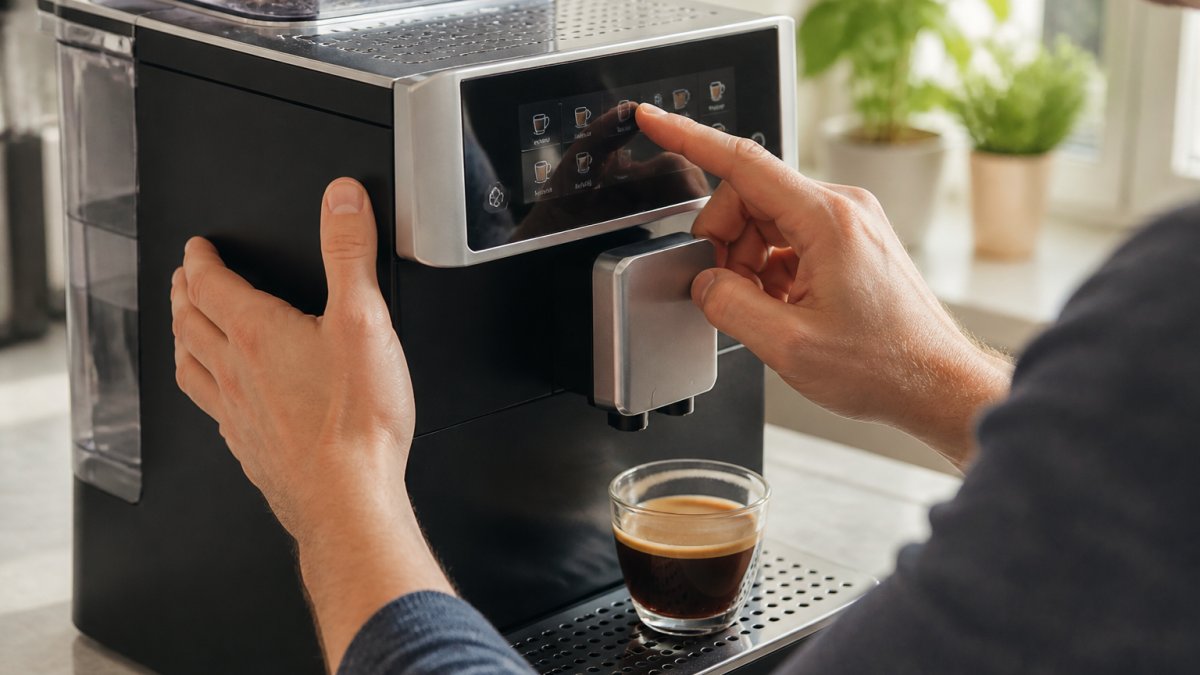
Here's the step-by-step process we recommend:
- Open the settings menu on your machine's display
- Choose the beverage you want to adjust
- Find the temperature or "brew temp" control
- Move it one or two steps, not five
- Save the setting and pull a test shot
- Taste, then repeat until it's right
Super-automatics handle grind and dose, so temperature is your main flavor control, learn the menu well.
The Best Water Temperature for Coffee: What the SCA Recommends
The best water temperature for coffee, per the Specialty Coffee Association, sits in the 195-205°F range, a sensible starting zone most roasters cite. But treating that range as a single answer is where home brewers get stuck.
Here is how to reconcile the SCA range with the roast-level starting points above:
| Roast Level | SCA Range Position | Practical Starting Point |
|---|---|---|
| Light roast | Top of range | 200-205°F |
| Medium roast | Middle of range | 197-202°F |
| Dark roast | Bottom of range | 190-195°F |
Dark roast starts below the SCA floor intentionally, the range is a general standard, not a roast-specific prescription. Porous dark beans release compounds quickly, so 195°F or below often produces a cleaner cup than 200°F.
Set-Point Temperature vs. Water-at-Contact Temperature
A kettle or machine display shows the set-point temperature inside the vessel. What hits your coffee is the water-at-contact temperature, almost always lower, heat escapes through the spout, the air gap during pouring, and the room-temperature brewer and carafe.
A 5-10°F drop between display and coffee bed is common in pour-over. If your kettle reads 205°F, the slurry may only reach 197-200°F, which matters most for light roasts needing the top of the range.
To reduce the gap:
- Preheat the brewer, carafe, and cup with hot water before brewing
- Pour from a low height to limit air exposure
- Brew immediately after the kettle reaches set-point
Altitude and Boiling Point
At higher elevations, water boils cooler: 212°F at sea level, near 203°F at 5,000 feet, closer to 197°F at 8,000 feet. Well above sea level, your "boiling" water may already sit at or below the SCA floor.
This is fine for dark roasts, which want cooler water, but a real constraint for light roasts. If elevation keeps your kettle below 205°F, extend brew time or grind finer to compensate.
Water Composition
Coffee is roughly 98% water, so what's in it matters. The SCA says water should be clean and free of strong flavors, and mineral content affects extraction.
- Too soft (low mineral): water can taste flat and under-extract, producing a weak cup
- Too hard (high mineral): water can over-extract and taste chalky or bitter
- Balanced: a middle ground of mineral content supports even extraction
If tap water tastes off, a carbon filter often fixes it. Very soft or hard water may need a brewing water recipe or coffee-specific bottled water. Test one change at a time.
Specialty Coffee Association water standards
Coffee Extraction Troubleshooting: Fix Sour or Bitter Shots
Coffee extraction troubleshooting comes down to taste: sour means under-extraction, bitter means over-extraction. Temperature is one of the fastest fixes for both.
Use this quick guide:
| Taste Problem | Likely Cause | Temperature Fix |
|---|---|---|
| Sour, thin, salty | Under-extraction | Raise temp a few degrees |
| Bitter, dry, harsh | Over-extraction | Lower temp a few degrees |
| Weak and watery | Too cool or coarse grind | Raise temp, check grind |
| Flat and lifeless | Temp drift or stale beans | Recheck temp, fresh beans |
Temperature isn't the only lever, grind size, brew time, and coffee-to-water ratio matter too, but it's the one most people ignore, and often the culprit.
Coming from a manual setup? Super-automatics react faster to temperature changes, so small steps go a long way.
How to Test and Dial In Your Temperature Settings
Most guides say "adjust to taste" and stop. This section gives you a controlled, repeatable fifteen-minute test, plus method-specific starting points the standard roast-level table doesn't cover.
The Controlled Temperature Test
Change only temperature while holding everything else constant. If grind, dose, water, and brew time drift, you won't know what fixed the cup.
What you need:
- One coffee, one roast level
- A scale accurate to 0.1 g
- A thermometer or a kettle with a reliable set-point
The method:
- Pick one coffee and one brew method. Do not switch beans mid-test.
- Lock your recipe: dose, water weight, grind setting, and brew time. Write them down.
- Set your starting temperature for that roast level (see the table above).
- Brew three cups at that temperature. Taste each one and record: sour, balanced, or bitter.
- Raise or lower the temperature by 2°F. Brew three more cups. Record again.
- Repeat in 2°F steps until you find the setting where the cup tastes sweet, smooth, and complete.
- Stop. That is your working temperature for this coffee and method.
Two degrees is small enough to be safe and large enough to taste. Jumps of 5°F or more skip past the sweet spot and obscure which direction helped.
Temperature Guidance by Brewing Method
Most recommendations focus on pour-over, but immersion, espresso, and batch brewing behave differently because contact time and pressure change extraction speed.
| Brew Method | Typical Starting Temp | Why It Differs |
|---|---|---|
| Pour-over | 195-205°F | Short contact, heat loss during pour |
| Immersion (French press, steep) | 195-205°F | Long contact, stable temperature |
| Espresso | 195-205°F at the group | Pressure drives extraction fast |
| Batch brewer | 195-205°F at the basket | Machine holds temperature steady |
In immersion brewing, water and grounds sit together for minutes, so temperature stays stable and extraction continues.
For espresso, group-head temperature matters more than the boiler display and can run a few degrees below set-point.
For batch brewers, the machine controls temperature, so your lever is the roast-level or brew-temperature setting.
Measurement and Heat Loss
Thermometer accuracy varies, a cheap instant-read may be off by 2-4°F, while a calibrated probe or verified kettle set-point is more reliable. Check yours against ice water at 32°F and boiling water at your elevation.
Heat loss happens at every step:
- Kettle to brewer: 2-5°F drop during pouring
- Brewer to coffee bed: 2-5°F drop as water hits room-temperature grounds
- Brewer to carafe: 2-4°F drop if the carafe is not preheated
Preheating the brewer and carafe recovers most of that loss, for light roasts, often the difference between a sour cup and a sweet one.
Troubleshooting by Taste
Temperature is one lever among several. Use this map to decide if it's the right fix.
| Taste | Likely Cause | Temperature Move | Other Checks |
|---|---|---|---|
| Sour, thin, salty | Under-extraction | Raise 2-4°F | Grind finer, extend time |
| Bitter, dry, harsh | Over-extraction | Lower 2-4°F | Grind coarser, shorten time |
| Weak and watery | Too cool or too coarse | Raise 2-4°F | Check dose and ratio |
| Flat and lifeless | Temp drift or stale beans | Recheck temp | Fresh beans, check water |
If raising temperature doesn't fix a sour cup, the problem is likely grind or brew time; same for a bitter cup that won't improve when lowered. Temperature is the fastest fix, not the only one.
Processing, Freshness, and Roast Development
Roast level is the starting point, but three factors can shift your ideal temperature:
- Processing: washed coffees tend to be cleaner and more forgiving; natural and honey-processed coffees can be fruitier and more sensitive to heat
- Freshness: very fresh beans release gas and can taste sharp; beans a week or two off roast often brew more evenly
- Roast development: two beans at the same roast level can differ if one was developed longer in the roaster
If a coffee tastes great at your usual temperature for its roast level, do not change it. If it tastes off, adjust in 2°F steps and taste again. The roast-level table is a starting point, not a rule.
Conclusion
Dialing in water temperature for different roasts takes patience, but it's the difference between a sour cup and a smooth, café-quality one. Most people never touch the setting, and that's why their coffee never improves.
At Modesto & Associates, we offer professional-grade, super-automatic espresso machines and high-quality milk cooling accessories designed to elevate your daily coffee ritual.
Get started with Modesto & Associates and pull a better shot tomorrow morning.
Frequently Asked Questions
What is the perfect water temperature for coffee?
The Specialty Coffee Association recommends brewing between 195°F and 205°F (90°C to 96°C). Within that range, light roasts benefit from the higher end around 200°F to 205°F, while dark roasts perform better at 195°F to 200°F. Your specific coffee roast temperature setting should be adjusted based on taste. If your coffee tastes sour, increase the temperature slightly. If it tastes bitter or harsh, lower it by a few degrees.
Does coffee roast level affect brewing temperature?
Yes, roast level directly affects the ideal brewing temperature. Light roasts have denser bean structures that resist extraction, so they need hotter water around 200°F to 205°F. Dark roasts are more porous and extract quickly, so cooler water around 195°F to 200°F prevents over-extraction and bitterness. Medium roasts sit comfortably in the middle at 198°F to 202°F. Adjusting coffee roast temperature to match your beans is one of the simplest ways to improve cup quality.
How do you change the water temperature on a super-automatic espresso machine?
Most super-automatic machines let you adjust temperature through the settings menu. Navigate to the brewing settings, find the temperature option, and use the arrow buttons to increase or decrease. Some machines offer three to five temperature levels rather than exact degrees. Start with the middle setting, brew a shot, and taste. If it tastes sour, go one level higher. If bitter, go one level lower. Check your machine's manual for specific steps.
Should light-roast coffee be brewed at a higher temperature?
Yes, light roasts should be brewed at the higher end of the range, around 200°F to 205°F. Light-roasted beans are denser because they spend less time in the roaster, making it harder for water to extract flavor compounds. Hotter water compensates for that density. If you brew light roast at 195°F, you will likely get a sour, thin cup because the water cannot pull enough sweetness and body from the grounds. Increase temperature before adjusting grind size.