 blog
Easy to Clean Espresso Machines 2026
Table of Contents
- What Makes an Espresso Machine Easy to Clean
- How to Clean a Super-Automatic Espresso Machine
- Self-Cleaning Espresso Machines: How They Work
- Removable Brew Group Espresso Machines
- Espresso Machines with Automatic Milk Cleaning
- Descaling and Long-Term Maintenance
- Cleaning Burden Over Time: What to Expect
- Frequently Asked Questions
Last Updated: October 9, 2026
What Makes an Espresso Machine Easy to Clean
Cleaning is the hidden cost of espresso machine ownership. Many buyers excited about café-quality drinks at home discover maintenance consumes more time than brewing.
An easy to clean espresso machine combines removable components, automatic rinse cycles, and accessible water pathways that don't trap coffee residue. We specialize in professional-grade, super-automatic espresso machines and high-quality milk cooling accessories designed to elevate your daily coffee ritual.
The best machines share three traits: tool-free removable parts, one-button automated cleaning routines, and milk systems that prevent buildup before it hardens.
Removable Components That Matter
The portafilter, brew group, and drip tray should come out easily. Machines requiring multiple disconnections to reach the brew group create friction that leads to skipped cleaning.
Look for brew groups that detach in one or two motions, and a filter basket and portafilter that are dishwasher-safe or easy to rinse by hand.
The steam wand deserves special attention. Milk residue hardens quickly, and wands with internal passages are notoriously difficult to clean.
Automatic vs. Manual Cleaning Cycles
Super-automatic machines often include built-in cleaning routines that flush water through the group head and internal passages.
Manual machines require you to backflush (run water backward through the group head) to clear grounds. It works if you remember, but it's easy to skip on busy mornings. Automatic cycles remove the guesswork.
The real advantage is consistency: the machine gets cleaned the same way every time, extending the lifespan of internal seals and gaskets.
How to Clean a Super-Automatic Espresso Machine
Super-automatic machines handle most grinding and brewing, but still need daily attention to prevent milk buildup and ground coffee drying inside the group head.
Daily Rinse and Purge Routine
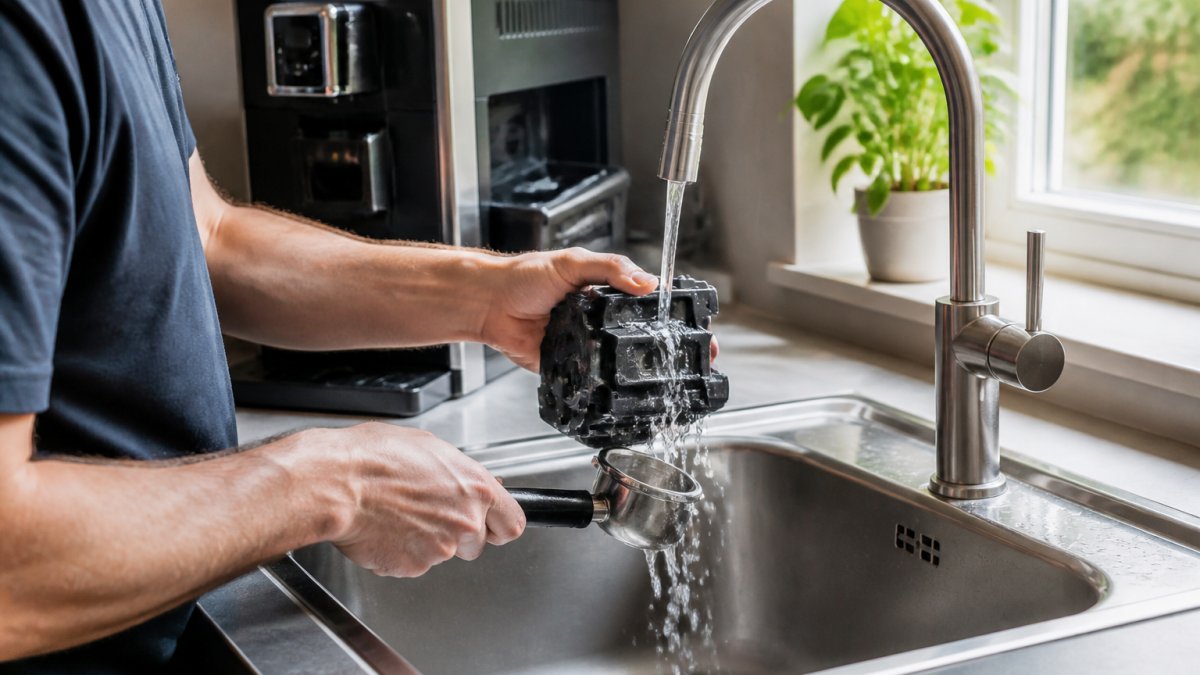
Each morning, run water through the group head without the portafilter.
After brewing, tap out grounds and rinse the portafilter and basket immediately; dried grounds become cement-like and require scrubbing. Use the included cleaning brush to wipe the group head opening.
For the steam wand, wipe it with a damp cloth right after steaming milk. Milk that dries on the wand becomes nearly impossible to remove without soaking.
Weekly Deep Cleaning Steps
Once a week, run the automatic cleaning cycle if your machine has one. Fill the tank, activate the function, and let it flush internal passages you can't reach by hand.
Check the shower screen (the metal piece that distributes water evenly across grounds). If it's removable, soak and scrub it.
Self-Cleaning Espresso Machines: How They Work
Self-cleaning espresso machines use automated water cycles to flush internal passages.
These cycles run 30 seconds to 2 minutes, and some repeat for thorough flushing.
Self-cleaning cycles don't replace physical removal of parts. You still need to soak and scrub the portafilter, basket, and steam wand by hand. Think of them as maintenance between weekly deep cleanings.
Removable Brew Group Espresso Machines
A removable brew group is the biggest cleaning advantage you can buy, but "removable" varies across machines. Removal is only half the story: what you can do with the part once it's out decides whether cleaning takes 90 seconds or 15 minutes.
What Actually Comes Out, and How
On machines with a true removable brew group, the brewing chamber slides out after you open a side door or lift a latch. No tools, hoses, or connectors.
On fixed-group machines, you clean in place: backflush with water and a blind basket, then scrub the shower screen and group gasket while mounted. It works, but you can't see the back of the shower screen or upper chamber, exactly where old coffee oils and grounds collect.
Dishwasher-Safe vs. Rinse-Only: Read the Manual
Manufacturer restrictions matter here. A removable brew group is almost never dishwasher-safe; seals, gaskets, and lubricated surfaces degrade in high heat and harsh detergent. Rinse-only is the norm.
What is commonly dishwasher-safe on well-designed machines:
- Drip tray and drip tray grate
- Portafilter basket (not the portafilter body, the handle and threads don't like dishwasher heat)
- Water tank, if the manufacturer lists it
- Some removable steam wand tips and milk carafe lids
What is almost never dishwasher-safe:
- The brew group itself
- Any part with rubber seals, O-rings, or silicone gaskets
- Milk carafes with internal valves or sensors
Side-by-Side Cleaning Task Breakdown
Here's the comparison most roundups don't publish. Times are for a machine that's been used once that day.
| Task | Removable brew group | Fixed group head |
|---|---|---|
| Rinse portafilter and basket | 30 sec | 30 sec |
| Purge group head | 5 sec | 5 sec |
| Remove and rinse brew group | 60-90 sec | Not applicable |
| Backflush with blind basket | Not required daily | 60-90 sec |
| Wipe shower screen | Not required daily | 30-60 sec |
| Wipe steam wand | 20 sec | 20 sec |
| Empty and rinse drip tray | 60 sec | 60 sec |
| Daily total | ~3 minutes | ~4-5 minutes |
Weekly, the gap widens. A removable brew group gets a 10-minute soak in espresso cleaning solution and a soft-brush scrub. A fixed group head needs a backflush cycle with detergent, a shower-screen soak if removable, and a group-gasket wipe, closer to 20 minutes.
Access and Mess Reduction
Before buying, check how easy it is to reach the grounds container, water tank, and drip tray.
Spill-prone designs share a pattern: a short gap between group head and drip tray, a narrow drip tray, and a grounds chute that misses the bin. A wide drip tray and deep grounds container cut daily wipe-downs noticeably.
The Trade-Off
Removable brew groups add a part, latch, and seal that can wear; expect to replace the brew-group gasket every year or two. For daily brewers that's usually worth it. If you brew once a week, a fixed group head with a disciplined backflush routine is perfectly serviceable.
Espresso Machines with Automatic Milk Cleaning
Milk systems are where many machines fail. Dried milk inside internal passages creates blockages and promotes bacterial growth. Automatic milk cleaning solves this by flushing the system with hot water after each use.
Why Milk System Hygiene Matters
Milk inside steam wands and internal tubes hardens within hours, then requires soaking and aggressive scrubbing. Bacteria also thrive in milk residue, affecting the taste of future drinks and creating hygiene concerns.
Automatic milk cleaning cycles activate after steaming, pumping hot water through the milk system to clear residue before it dries. Some systems self-purge a small amount of water through the wand every few hours.
Dishwasher-Safe Milk Frother Components
The easiest solution is a removable, dishwasher-safe milk frother or steam wand tip: remove it after use, rinse, and pop it in the dishwasher. No soaking, no scrubbing.
Look for machines where the milk frother detaches without tools. Some include multiple attachments so you can swap one out while another soaks, eliminating the most tedious part of maintenance.
Descaling and Long-Term Maintenance
Descaling is the task owners postpone longest, and the one most likely to shorten a machine's life. Most guides say to descale but not how often, with what, or what it costs in time and consumables over a year.
How Often You Actually Need to Descale
Frequency tracks water hardness, not the calendar. The U.S. Geological Survey classifies water as soft below about 60 mg/L of calcium carbonate, moderately hard around 60-120 mg/L, hard around 120-180 mg/L, and very hard above 180 mg/L.
A practical schedule:
- Soft water: every 3-4 months
- Moderately hard: every 2-3 months
- Hard: every 4-8 weeks
- Very hard: every 3-4 weeks, or use filtered or bottled water
If your machine has a descaling prompt, trust it over the calendar. Prompts are tied to a flow meter or the hardness setting you enter during setup; set hardness correctly and the prompt becomes genuinely useful.
The Descaling Process, Step by Step
- Empty the water tank and remove the filter if you use one.
- Mix descaling solution per the manufacturer's ratio, usually one part descaler to 10-20 parts water.
- Fill the tank and place a large container under the group head and steam wand.
- Run the machine's descaling program if it has one. If not, run half the tank through the group head and half through the steam wand in short bursts.
- Let the solution sit in the internal passages for 15-20 minutes.
- Flush with at least two full tanks of fresh water, running some through the steam wand.
- Reinstall the water filter and run one more rinse cycle before brewing.
Total time is roughly 30-45 minutes, but most of it is waiting.
What to Use, and What Not To
Use a descaling solution formulated for espresso machines; citric-acid and lactic-acid blends are common and gentle on seals. Avoid household vinegar, whose acetic acid can degrade rubber gaskets and leave an odor in your first few shots.
Consumables and Time Over a Year
The ownership-cost picture for a daily-brewing household:
- Descaling solution: one bottle typically covers 3-5 descale cycles, so 2-4 bottles a year depending on water hardness
- Cleaning tablets: roughly one tablet per weekly deep clean, so 50 or so a year
- Water filters: 4-6 replacements a year if you use one
- Brew-group gasket: one replacement every 1-2 years on removable-group machines
- Milk-system cleaner: if you have an automatic frother, one bottle every 2-3 months
Time-wise, plan on 5-10 minutes daily, 15-20 minutes weekly, and 30-45 minutes monthly for descaling, roughly 40-60 hours a year. A machine designed for easy cleaning cuts that meaningfully, mostly by removing backflush and disassembly steps.
Signs You're Overdue
- Longer heat-up times
- Reduced steam pressure
- A white or chalky film in the water tank or drip tray
- Coffee that tastes flat or slightly metallic
- The descaling prompt firing more often than expected
If you see two or more, descale before your next brew session. Scale hardening inside the boiler or thermoblock is the most common cause of expensive repairs, and it's almost entirely preventable.
Cleaning Burden Over Time: What to Expect
The machines that stay in regular use are the ones where daily cleaning feels frictionless.
Over a year, the difference between a machine that's easy to clean and one that isn't adds up to dozens of hours.
Finding an espresso machine that delivers café-quality drinks without demanding hours of maintenance each week is realistic.
Frequently Asked Questions
What is the easiest espresso machine to clean?
Super-automatic espresso machines with removable brew groups and automatic milk cleaning systems are the easiest to maintain. Look for models that offer one-touch cleaning cycles, dishwasher-safe components, and automatic rinse prompts. Machines with self-cleaning programs reduce manual scrubbing, while removable parts let you clean each component separately without disassembly. The best easy to clean espresso machines combine automatic functions with accessible design.
Are super-automatic espresso machines easier to clean than manual machines?
Yes, super-automatic espresso machines are significantly easier to clean than manual or semi-automatic models. They feature automatic rinse cycles, self-cleaning programs, and often have removable brew groups that simplify maintenance. Manual machines require hands-on backflushing and more detailed attention to the portafilter and group head. Super-automatic models reduce daily cleaning time from 10-15 minutes to just 2-3 minutes of routine maintenance.
How often should you clean an espresso machine?
Daily cleaning includes a rinse cycle and purge after each shot to clear residual grounds. Weekly deep cleaning involves removing and soaking the brew group, portafilter, and basket. Descaling should happen every 3-6 months depending on water hardness and usage frequency. Milk system components need cleaning after every use to prevent buildup. Most modern machines include automatic prompts that alert you when descaling is due, taking the guesswork out of maintenance schedules.
Do espresso machines with milk systems require more cleaning?
Yes, milk systems add cleaning complexity because milk residue can harden and clog steam wands and internal tubes. However, machines with automatic milk cleaning significantly reduce this burden. Look for models that offer automatic rinse cycles for the milk frother or integrated cleaning programs. Removable and dishwasher-safe milk components make routine cleaning much faster. Without automatic features, milk system maintenance can add 5-10 minutes to your daily routine.