 blog
Home Barista Essentials for Small Kitchens
Table of Contents
- The Small Kitchen Barista Workflow
- Compact Espresso Machines for Apartments
- Space-Saving Coffee Grinders
- Milk Frothing and Texturing Accessories
- How to Organize a Home Coffee Bar
- Multi-Functional Gear for Tight Quarters
- Frequently Asked Questions
Last Updated: September 28, 2026
The Small Kitchen Barista Workflow
Building a genuine café setup in a cramped kitchen comes down to one idea: treat your counter like a production line, not a showroom. This guide from Modesto & Associates covers the home barista essentials for small kitchens that earn their footprint, and the ones that waste it.
Most small-kitchen coffee setups fail for the same reason: gear gets bought in the wrong order. People buy a machine first, then find there's nowhere to put a grinder, no room to tamp, and no drawer for beans.
A better sequence is storage, then grinding, then brewing, then milk. Each stage gets a defined zone and each tool exactly one home. Get that right and a 60-centimeter stretch of counter can outperform a cluttered coffee cart twice its size.
Vertical Storage and Wall-Mounted Solutions
Floor and counter space are the scarcest resources in a small kitchen, so the most valuable square footage is often the wall. A wall-mounted shelf above the machine holds mugs, airtight bean canisters, and filter paper without consuming an inch of work surface.
Magnetic strips for tamper and distribution tools, under-cabinet hooks for pitchers, and a slim pull-out drawer for knock box liners all follow the same principle: keep the counter clear for the grinder and the machine.
The trick most people miss is height.
Acoustic Impact in Small Apartments
Espresso equipment is loud, and small apartments have thin walls. A rotary pump machine runs quieter than a vibration pump model, and a manual grinder is nearly silent next to an electric burr grinder working through a dark roast at 7 a.m.
Compact Espresso Machines for Apartments
The best compact espresso machine for an apartment fits under your upper cabinets with room to load the water tank from the front, not the top. Front-loading tanks are the most overlooked spec in small-kitchen shopping, the difference between a machine you can refill and one you drag out every morning.
The Specs That Actually Matter in a Small Kitchen
- Boiler type. A single boiler heats brew and steam in one chamber, so you wait between pulling a shot and steaming milk. A dual boiler or heat exchanger does both at once but adds height and cost. Thermoblock and thermocoil designs heat water on demand in a narrow channel, which is why many of the slimmest machines use them.
- Pump type. Vibration pumps are common in compact machines but louder and less consistent at pressure. Rotary pumps are quieter and hold pressure better, but usually appear in larger, heavier machines. With shared walls, this spec decides whether your 6 a.m. shot wakes the neighbor.
- Wattage and circuit load. Most compact machines draw 1,200 to 1,500 watts. A standard 15-amp kitchen circuit handles that alongside a grinder, but not a microwave or electric kettle at the same time. On one circuit, stagger your appliances.
- Portafilter size. A 58 mm portafilter is the commercial standard with the widest accessory ecosystem. Many compact machines use 51 mm or 54 mm baskets, limiting which tampers, distribution tools, and bottomless portafilters you can buy. Check before committing to a tool set.
- Water tank access and capacity. A 1-liter tank is roughly 8 to 10 shots. A 2-liter tank doubles that but adds footprint. Front-loading or side-loading tanks are easier to refill under cabinets than top-loading ones.
Super-Automatic vs. Manual: What Fits Your Space
Super-automatic machines grind, dose, tamp, and brew at the push of a button, so one appliance replaces a grinder, tamper, scale, and distribution tool. In a small kitchen, that consolidation is the real feature. Manual setups offer more control but spread the job across four or five objects that all need a home.
| Setup Type | Counter Space Used | Daily Effort | Best For |
|---|---|---|---|
| Super-automatic | One appliance footprint | Press one button | Tight counters, busy mornings |
| Semi-automatic + grinder | Two to three footprints | Tamp, dose, time the shot | Enthusiasts with room to spare |
| Manual lever + hand grinder | Two footprints, low height | Full hands-on routine | Smallest kitchens, quietest brewing |
Space-Saving Coffee Grinders
A dedicated burr grinder is the upgrade that changes the most cups per dollar, and it doesn't have to be large. Hand grinders store in a drawer and take up zero counter space; compact electric burr grinders run about the size of a large mug. But in a small kitchen, the decision isn't just size, it's noise, retention, and how often you'll crank a handle before 7 a.m.
Conical Burr Grinders vs. Blade Grinders
Conical burr grinders crush beans between two shaped surfaces, producing even particles that extract consistently. Blade grinders chop with a spinning blade, leaving powder and chunks that pull uneven shots no matter how good the machine is.
The Noise Question Nobody Talks About
Grinder noise is the most under-discussed constraint in small-apartment coffee setups. A hand grinder is nearly silent, only the burrs cutting beans, but grinding 18 grams for a double shot takes 30 to 60 seconds of effort depending on the burr set and roast. A compact electric burr grinder does the same work in 8 to 15 seconds but can hit 80 to 90 decibels, roughly a garbage disposal.
- Place the grinder on a rubber anti-vibration mat. This reduces both the noise transmitted through the counter and the vibration that makes the grinder walk across the surface.
- Keep it off shared walls. A grinder placed against a wall that backs onto a neighbor's bedroom transmits more sound than one placed on an interior counter.
- Consider a hand grinder for early mornings and an electric for weekends. Many small-kitchen baristas keep both: the hand grinder lives in a drawer for the 6 a.m. shot, the electric handles the weekend session.
- Look for grinders with rubber-mounted motors or sound-dampening housings. These are marketed for noise reduction and do make a measurable difference, though they add cost.
Retention and Freshness in Small Batches
Retention is the ground coffee left inside the grinder after you finish grinding. A high-retention grinder can hold 1 to 2 grams of stale grounds that mix into your next shot. In a small kitchen where you pull one or two shots a day, that stale coffee is a larger proportion of your dose than in a café pulling hundreds.
Milk Frothing and Texturing Accessories
Milk texturing is where home setups either feel professional or feel like a compromise. A stainless milk frothing pitcher with a proper spout is the only tool you truly need for latte art, and it nests inside larger pitchers to save cabinet space.
How to Organize a Home Coffee Bar
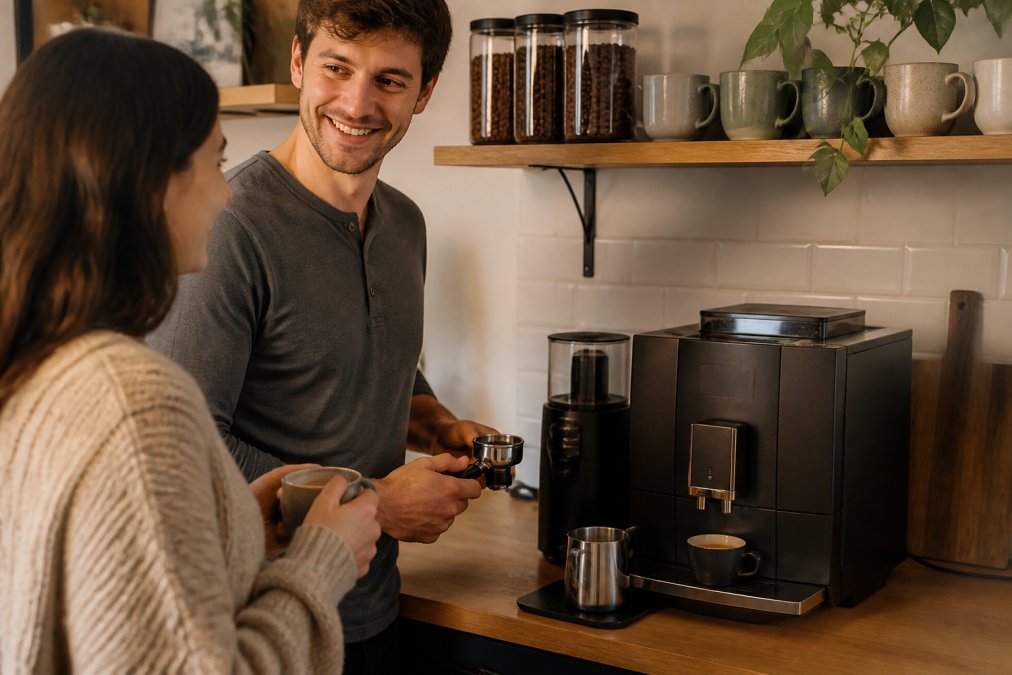
Organize a home coffee bar by splitting it into four zones, left to right in the order you use them: beans, grind, brew, finish. Everything within a zone stays within arm's reach, and nothing crosses into another zone's space.
Multi-Functional Gear for Tight Quarters
Every item on a small coffee bar should do at least two jobs. A precision scale with a built-in timer handles dosing and extraction time in one object. A distribution tool that doubles as a tamper replaces two tools with one.
Frequently Asked Questions
What are the most space-efficient espresso machines for small kitchens?
Compact espresso machines for apartments typically measure 7 to 10 inches wide, so measure your counter depth before buying. Super-automatic models save space by combining grinding, tamping, and brewing in one unit, eliminating separate tools. Look for a machine with a slim footprint, a removable drip tray, and a built-in water filtration system. Brands like Modesto & Associates offer professional-grade super-automatic options designed for tight counters. Always check the machine's clearance for bean hopper access and cup height.
How do you organize a coffee station in a small apartment?
Start with vertical storage: install a wall-mounted shelf or magnetic strip above the machine for cups, filters, and tools. Group items by workflow, grinder next to espresso machine, tamper and knock box within arm's reach. Use airtight storage canisters for beans to preserve freshness and reduce clutter. A compact tamping mat keeps the area clean. If noise is a concern, place the machine on a rubber mat to dampen vibration. Aim for a minimalist coffee bar where every item has a dedicated spot.
What are the essential tools every home barista needs?
At minimum, you need a grinder with conical burr burrs for consistent grind size, a precision scale for brewing ratio accuracy, and a tamper that matches your portafilter size. A milk frothing pitcher is necessary for latte art and texturing. A knock box simplifies puck disposal. For small kitchens, choose a space-saving coffee grinder and multi-functional tools like a distribution tool that also tamps. An airtight storage container keeps beans fresh. These tools support shot consistency without requiring a full commercial setup.
Can you get café-quality coffee with compact equipment?
Yes, if you prioritize grind quality, water filtration, and temperature stability. Compact super-automatic machines from Modesto & Associates deliver barista-quality coffee by automating tamping pressure and extraction time. Pair with a conical burr grinder and a precision scale to dial in your brewing ratio. Fresh beans stored in airtight containers make a bigger difference than machine size. Many compact setups now include steam-free frothers for milk texturing, so you can produce café-standard drinks without a large footprint.