 blog
blog
Breville vs Jura Espresso Machine Comparison
Table of Contents
- Breville vs Jura Espresso Machine Comparison: Core Differences
- Super-Automatic vs Semi-Automatic Espresso Machines
- Milk Texturing and Frothing Capabilities
- Cost of Ownership for High-End Coffee Machines
- Espresso Machine Maintenance and Cleaning Tips
- Workflow Comparison for Specific Drink Types
- Which Brand Fits Your Kitchen and Routine?
- Frequently Asked Questions
Last Updated: September 13, 2026
Breville vs Jura Espresso Machine Comparison: Core Differences
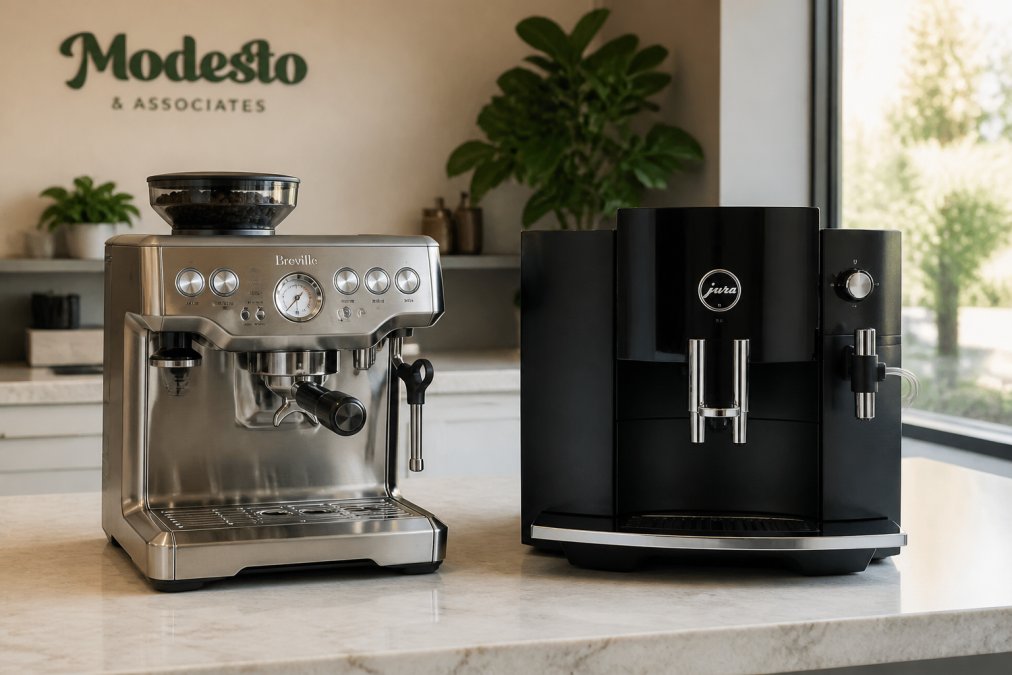
The breville vs jura espresso machine comparison comes down to one question: do you want to be a barista, or do you want to be served like one? Breville builds semi-automatic machines that reward hands-on control, while Jura builds super-automatic machines that handle everything from grind to cleanup with one touch. At Modesto & Associates, we sell super-automatic equipment. Below, we break down grinding, milk texturing, cost of ownership, maintenance, and workflow so you can pick the machine that matches how you actually make coffee.
Super-Automatic vs Semi-Automatic Espresso Machines
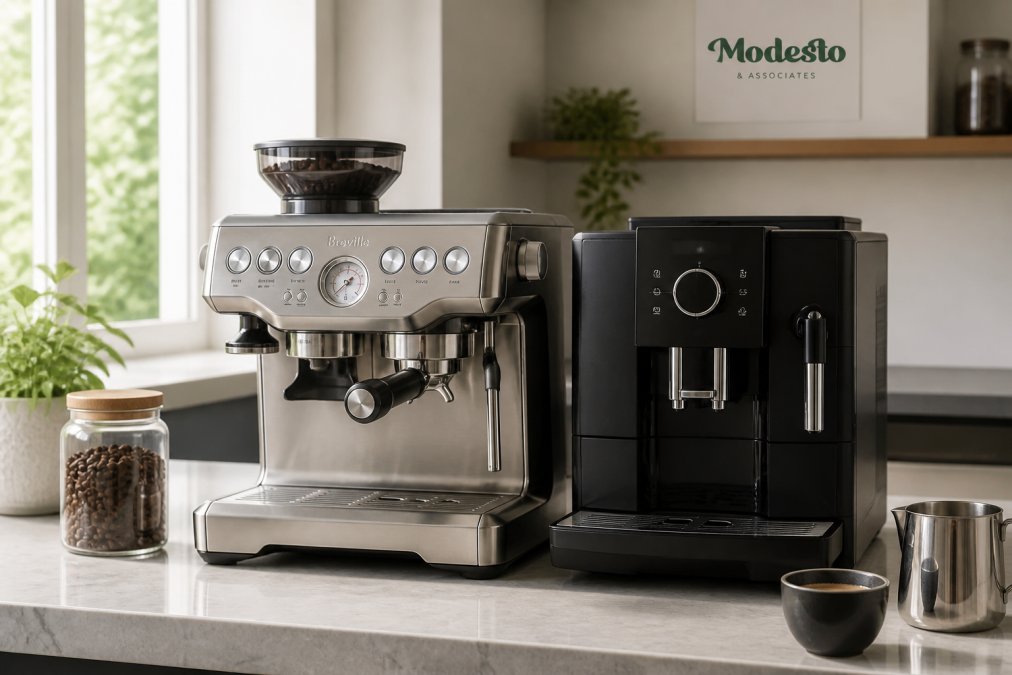
A super-automatic espresso machine grinds, doses, tamps, extracts, and often textures milk with a single button press (home-barista.com). A semi-automatic machine automates water delivery and pump pressure but leaves grinding, dosing, and tamping to you. That single difference shapes everything else: counter footprint, daily effort, and how consistent your shots taste.
How Each Type Handles Grinding and Tamping
Jura machines use an integrated conical burr grinder and tamp internally, so grind size adjustment happens through a menu setting rather than a physical dial. Breville machines typically pair with a separate or built-in grinder, and the user tamps manually into the portafilter. In practice, this means Jura delivers near-identical shots every morning, while Breville lets you chase a better extraction by changing dose, tamp pressure, and grind size. The trade-off is real: manual tamping introduces variables that take weeks to master, and those variables are exactly what super-automatic buyers pay to eliminate.
Milk Texturing and Frothing Capabilities
Milk texturing is where the two approaches diverge most visibly. Jura's automatic milk systems draw milk from a container or integrated cooler and produce consistent microfoam at a set temperature. Breville's steam wands give you full control over aeration and stretching, which is how you get the dense, glossy microfoam a latte art pour needs.
The honest limitation: automatic frothers rarely match a skilled hand on texture, and manual steaming has a learning curve that frustrates beginners. If your household drinks mostly lattes and cappuccinos on autopilot, automatic wins. If you want to improve your technique, the wand teaches you.
Cost of Ownership for High-End Coffee Machines
Upfront price is the smallest part of the equation. The real comparison is a three-line budget: purchase price, recurring consumables, and service events. Most buyers only model the first line, which is why the value argument flips after year two.
The Consumable Stack
Super-automatic machines run on a proprietary consumable loop. Expect to budget for:
- Water filters, cartridge-style filters that clip into the tank or inline housing, replaced on a volume or time schedule the machine tracks.
- Cleaning tablets, used in a programmed cleaning cycle, typically one tablet per cycle.
- Descaling solution, required on a hardness-driven schedule, not a calendar one.
- Milk system cleaner, for machines with integrated milk circuits, this is a separate consumable from the brew-group tablets.
- Bean hopper and grounds bin liners or gaskets, small, cheap, and easy to forget.
Semi-automatic machines share some of these (descaler, group-head detergent, a scale, a tamper, and often a standalone grinder), but the consumables are generic rather than proprietary. That single difference, proprietary versus generic, is the largest long-term cost divider in this category.
Repairability Index: What You Can Fix Yourself
This is the breakdown most comparisons skip. Rank the two machine types by how much of the failure surface a competent owner can address:
| Component | Super-Automatic | Semi-Automatic |
|---|---|---|
| Brew group | Removable on many models, user-serviceable with guidance | Group head is simple; gaskets and screens are user-replaceable |
| Grinder burrs | Often internal; replacement may require service | Standalone grinder burrs are user-replaceable |
| Pump | Typically service-only | Frequently user-replaceable |
| Boiler / thermoblock | Service-only; scale damage is the usual cause | Service-only, but simpler to access |
| Milk circuit | User-cleanable, occasionally service-only for seals | Steam wand is user-serviceable |
| Electronics / display | Service-only | Service-only |
The pattern: super-automatics concentrate more failure points into a sealed chassis, so a higher share of repairs route to a technician. Semi-automatics spread the same functions across simpler, more accessible parts. Neither is cheap to service, the difference is how often you have to.
Break-Even Math Against Café Spend
The buyer question we hear most is how long it takes to break even against coffee shop visits. The math is simple: multiply your weekly café spend by 52, then compare that annual figure to the machine plus its yearly consumables and an amortized service allowance. Heavy café users often find the crossover arrives faster than expected, though the exact timeline depends on your habits and your water.
Pricing for the machines we carry depends on the model and current promotions, so check our site for current pricing.
Espresso Machine Maintenance and Cleaning Tips
Espresso machine maintenance and cleaning tips matter more than most buyers expect. Every machine in this category needs a rhythm, not occasional attention, and the rhythm differs by machine type because the internal surfaces differ.
Daily, Weekly, Monthly
- Rinse the brew group or flush the group head daily
- Empty and rinse the drip tray and grounds bin daily
- Purge and rinse the milk circuit after every milk drink, residual milk is the fastest path to a clogged frother
- Run a cleaning cycle with proprietary cleaning tablets weekly
- Check water filter status monthly
- Run a full descaling cycle on the schedule your water hardness dictates
- Inspect the bean hopper for oils and stale residue monthly
- Backflush the group head on semi-automatics with a blind basket and detergent
Why Water Chemistry Drives the Schedule
Water hardness is the most overlooked cost driver in this category, and it affects the two machine types differently. Hard water scales the boiler and internal plumbing, which shortens service life and degrades brewing temperature stability (sca.coffee). A simple hardness test strip tells you where you stand.
The mechanism matters: scale is an insulator. As it builds on a boiler or thermoblock surface, the heating element has to work harder to reach the same temperature, and the temperature it actually delivers to the puck drifts (PubMed). On a super-automatic, that drift happens inside a sealed brew unit you cannot see, so the machine compensates until it faults. On a semi-automatic, you can often taste the drift earlier because you are pulling shots by feel and adjusting grind.
A common pattern: the same water that is fine for a drip brewer will shorten the life of an espresso machine, because espresso machines run hotter and cycle more often. The fix is either a filtration system sized to your hardness or a descaling schedule matched to it, not a fixed calendar interval.
What Each Machine Type Makes You Do
Super-automatics automate the rinse and cleaning cycles, which raises compliance, the machine nags you. Semi-automatics put the routine in your hands, which means the maintenance is simpler per step but easier to skip. The failure mode is different too: a neglected super-automatic tends to fail in the milk circuit or brew unit; a neglected semi-automatic tends to fail at the group gasket, the shower screen, or the boiler from scale.
| Factor | Super-Automatic | Semi-Automatic |
|---|---|---|
| Daily effort | One touch | Manual dose and tamp |
| Consistency | High | Depends on skill |
| Cleaning routine | Automated cycles | Manual, daily |
| Repairability | Fewer service points | Simpler internals |
| Best for | Busy households | Hands-on enthusiasts |
Workflow Comparison for Specific Drink Types
Drink type should drive your decision more than brand loyalty. A straight espresso drinker gets more from a semi-automatic, because shot volume, grind size adjustment, and pre-infusion control let you dial in flavor. A latte or cappuccino household gets more from a super-automatic, where milk texturing and espresso extraction happen in sequence without you standing at the machine.
Entertaining changes the calculus. When you have guests, a one-touch machine produces drinks back to back without a queue forming at the counter. That workflow efficiency is the whole point of automation, and it is why we offer machines with integrated milk cooling: the milk stays at a safe temperature through a long brunch instead of sitting warm on the counter.
Which Brand Fits Your Kitchen and Routine?
Counter space decides as often as preference does. Super-automatic machines concentrate the grinder, brew unit, and milk system into one chassis, which can actually save space versus a semi-automatic setup plus a separate grinder. Measure your available counter depth and height clearance before anything else, and check the drip tray capacity and bean hopper size if you dislike frequent refills.
For most busy professionals, the super-automatic route is the better fit. That is the category Modesto & Associates specializes in, and it is why we pair our machines with integrated milk cooling rather than treating milk as an afterthought. If you want café-standard beverages without the manual steps, a super-automatic machine with proper milk handling is the shortest path there.
Frequently Asked Questions
Which is better, Jura or Breville?
Neither is universally better. Jura machines are typically super-automatic, meaning they grind, tamp, and brew with one touch, which suits busy professionals who want consistency with minimal effort. Breville offers both semi-automatic and super-automatic models, so the brand appeals to users who enjoy hands-on control over grind size adjustment and tamping. Your choice depends on whether you prioritize workflow efficiency or the ritual of manual espresso extraction.
Is a super-automatic machine worth the investment over a semi-automatic?
It depends on your daily routine. Super-automatic machines handle grinding, tamping, and shot volume automatically, which reduces the learning curve and delivers consistent results every time. Semi-automatic machines cost less upfront but require more user input and practice. If you entertain guests often or want barista-quality drinks without the time commitment, a super-automatic model typically justifies the higher initial cost through convenience and reduced waste.
How do I maintain a high-end espresso machine to protect my investment?
Run a descaling cycle according to your water hardness level, typically every two to three months. Empty the drip tray and bean hopper regularly, and use proprietary cleaning tablets as directed. Rinse the milk system after every use to prevent residue buildup. These steps preserve thermal stability, protect the conical burr grinder, and extend service life, which directly lowers your cost of ownership over time.
What coffee machine is comparable to Jura for milk-based drinks?
Several super-automatic machines match Jura on milk texturing and microfoam quality. Look for models with integrated milk cooling solutions, adjustable milk temperature, and programmable profiles for drinks like lattes and cappuccinos. Machines with a PID controller and pre-infusion produce more consistent crema quality and flavor. Compare pump pressure, flow rate, and milk system design rather than brand name alone when evaluating options for milk-heavy drink menus.
The real challenge is not choosing a brand. It is matching the machine to the mornings you actually have, then keeping it maintained well enough to last. Modesto & Associates builds its selection around professional super-automatic machines with integrated milk cooling, so your daily ritual stays one touch from start to finish. Get started with Modesto & Associates and turn your kitchen into the coffee bar you keep driving past.