 how-to
How to Stop Bitter Espresso Shots: 7 Fixes That Work
Table of Contents
- Why Your Espresso Tastes Bitter
- Espresso Extraction Troubleshooting: Quick Diagnosis
- How to Adjust Espresso Grind Size
- Finding the Ideal Espresso Brew Ratio
- Water Temperature and Pressure: The Hidden Variables
- Bean Freshness, Roast Level, and Basket Geometry
- Sensory Calibration: Training Your Palate
- Conclusion
- Frequently Asked Questions
Last Updated: September 29, 2026
Why Your Espresso Tastes Bitter
Bitter espresso comes from over-extraction: too much of the coffee's soluble material ends up in your cup. When hot water stays in contact with coffee grounds too long, or the grind is too fine, it pulls out harsh compounds along with the good stuff. This is the single most common home espresso problem, and it is also the most fixable.
The Science of Over-Extraction
Over-extraction is the process of dissolving too much from the coffee bean, including the bitter compounds that normally stay locked in the grounds. Solubility works on a timer. The first compounds to dissolve are acids and sugars, which taste bright and sweet. Keep going, and you hit tannins and other bitter compounds. The fix is not a new machine. It is control over four variables: grind size, brew ratio, water temperature, and shot time.
Espresso Extraction Troubleshooting: Quick Diagnosis
Start with a taste test, then match the symptom to the fix. This table covers the most common problems and what to change first.
| Symptom | Likely Cause | First Fix |
|---|---|---|
| Sharp, bitter, dry finish | Over-extraction | Coarsen grind, shorten shot |
| Sour, thin, salty taste | Under-extraction | Finer grind, longer shot |
| Gushing, pale flow | Grind too coarse | Grind finer in small steps |
| Slow drip, almost no flow | Grind too fine | Grind coarser, check dose |
| Bitter and watery at once | Channeling | Improve puck preparation |
| Bitter only at the end | Shot ran too long | Cut yield earlier |
| Bitter on some sips, sweet on others | Uneven extraction / channeling | Level the bed, distribute, tamp flat |
| Bitter and hollow at the same time | Water too hot or too hard | Drop temp 2°F, check water |
Reading the Flow Rate
Flow rate is the fastest diagnostic you have. A healthy 18 g dose at a 1:2 ratio should reach first drip in roughly 5 to 10 seconds and finish near 25 to 30 seconds. If first drip shows up at 3 seconds, the puck is offering little resistance, usually too coarse a grind or a channel. If first drip takes 15 seconds or more, the puck is choking, usually too fine a grind, too high a dose, or too much tamp pressure.
Puck Prep and Tamping Pressure
Tamping pressure is the most overrated variable in home espresso. Once you press hard enough to fully compress the bed, roughly 15 to 30 pounds of force, extra pressure does almost nothing. What matters is that the tamp is level and consistent. A tilted tamp creates a thin side and a thick side, and water always finds the thin side first.
A repeatable puck prep routine:
- Dose by weight onto a scale, not by scoop.
- Break up clumps with a distribution tool or a quick stir with a needle tool.
- Level the bed with a light tap or a leveling tool.
- Tamp straight down until the bed stops compressing, then stop.
- Wipe the rim and lock the portafilter in promptly.
Channeling: The Hidden Cause of Bitter Shots
Channeling is when water punches a narrow path through the puck instead of pushing evenly through all of it. The channel gets over-extracted (bitter) while the rest of the puck gets under-extracted (sour). The result is a shot that tastes both bitter and weak, a combination that confuses most home baristas because neither grind direction fixes it.
Common channeling triggers:
- Uneven distribution of grounds in the basket
- A tamp that is not level
- A basket with irregular or worn holes
- A grind that is too fine, causing the puck to fracture under pressure
- A dose that leaves too much headspace or not enough
How to Adjust Espresso Grind Size
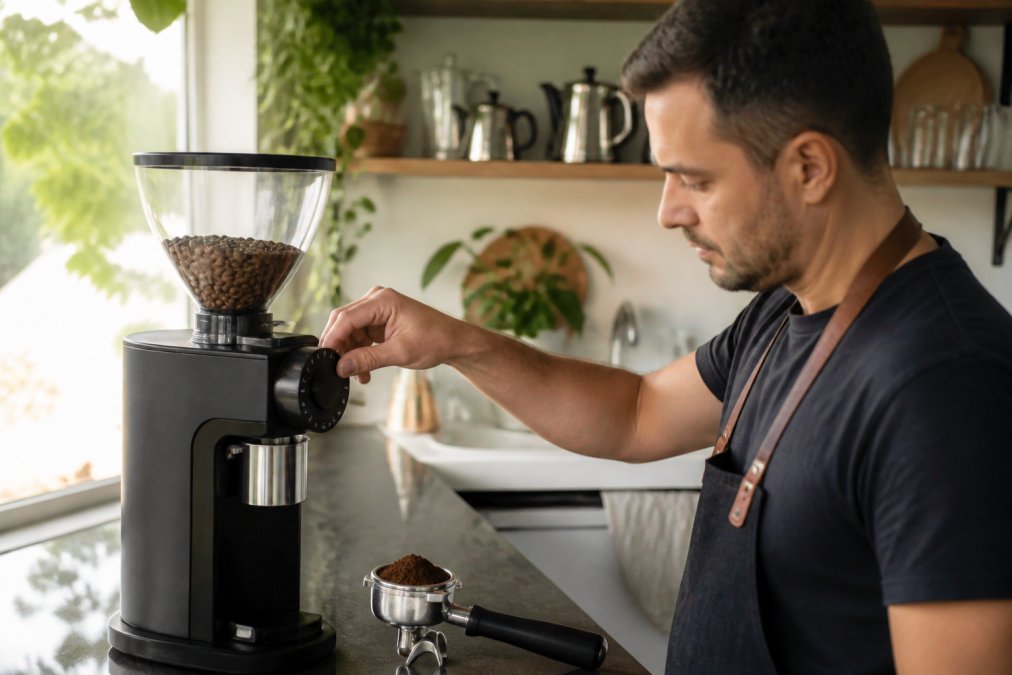
Grind size is the biggest lever you have. A small turn of the dial changes how fast water moves through the puck, and that changes everything about the taste.
Dialing In Your Burr Grinder
Follow these steps to dial in your burr grinder without wasting a bag of beans:
- Start with a medium-fine setting as your baseline.
- Pull one shot and time it from first drip to finish.
- If it tastes bitter, turn the dial one step coarser.
- If it tastes sour, turn one step finer.
- Pull another shot and taste again.
- Repeat in single steps until the shot tastes balanced.
Finding the Ideal Espresso Brew Ratio
The ideal espresso brew ratio is 1:2 by weight for most beans: one gram of dry coffee to two grams of liquid espresso in the cup. A standard dose of 18 grams should yield about 36 grams of espresso. This is the starting point, not a rule set in stone.
- Dose: weigh your coffee, do not scoop it
- Yield: weigh the liquid in the cup
- Time: aim for 25 to 30 seconds
- Adjust one variable per shot
Water Temperature and Pressure: The Hidden Variables
Water temperature decides which compounds dissolve. Most home machines run best between 195°F and 205°F (about 90°C to 96°C). Push hotter, and you pull bitter compounds fast. Drop too cool, and the shot turns sour.
Bean Freshness, Roast Level, and Basket Geometry
Fresh beans and the right basket do more for flavor than any gadget. Coffee peaks roughly one to three weeks after its roast date. Beans older than that taste flat and stale, and no grind adjustment fixes them. Store beans in an airtight container away from light and heat, and skip the freezer for daily use.
Basket Geometry and Precision Baskets
Basket geometry is the variable most guides ignore. A precision basket with uniform, laser-cut holes gives you even flow, which means fewer bitter pockets and less channeling. A worn or cheap basket with irregular holes will fight you on every shot, no matter how good your grinder is.
What to look for:
- Hole uniformity. Precision baskets have consistent hole size and spacing. Stamped baskets vary, and the variance creates channeling.
- Basket diameter. A 58 mm basket is the common commercial size; 54 mm and 51 mm baskets behave differently and need their own grind settings.
- Capacity. A basket rated for 18 g wants roughly 18 g. Under-dosing a large basket leaves too much headspace and causes the puck to break up.
- Condition. A basket that has been scrubbed with abrasive pads or run through a dishwasher can lose its coating and its hole geometry.
Grinder Consistency: Burrs, Fines, and Boulders
"Grind coarser" only works if your grinder produces a consistent particle size. A dull or misaligned burr set produces fines (dust-like particles that over-extract and taste bitter) and boulders (large particles that under-extract and taste sour) in the same dose. The result is a shot that tastes bitter and sour at once, and no grind setting fixes it because the problem is the spread, not the average.
Signs your grinder is the bottleneck:
- The same setting produces different shot times day to day
- The puck surface looks muddy in some spots and dry in others
- You see visible dust on the grounds
- The grinder has run for years without new burrs
Equipment Maintenance and Cleaning
A dirty machine makes bitter espresso no matter how well you dial in. Old coffee oils go rancid, and rancid oils taste bitter. This is the most overlooked cause of bitterness in home setups.
A simple maintenance rhythm:
- Daily: rinse the portafilter and basket, flush the group head, wipe the steam wand.
- Weekly: backflush with water (and with a cleaning detergent if your machine supports it), scrub the basket with a dedicated espresso cleaner, not dish soap.
- Monthly: remove and soak the shower screen and dispersion screw, descale if your water is hard, and check the group gasket for wear.
- As needed: replace burrs, gaskets, and shower screens when they show wear.
Sensory Calibration: Training Your Palate
You cannot fix bitterness you cannot taste. Sensory calibration is the practice of training your palate to name what you taste. It is the skill that separates people who dial in a shot in two tries from people who guess all week.
Try this routine once a week:
- Taste your shot and write down three words for it
- Compare it to a known reference, like a piece of dark chocolate
- Note where the bitterness hits: front, middle, or back
- Track your notes next to your grind and yield settings
Conclusion
Bitter espresso is a signal, not a mystery. It tells you the shot pulled too much from the grounds, and every fix starts with one change at a time: coarser grind, shorter yield, cooler water, fresher beans.
Frequently Asked Questions
Why is my espresso shot bitter?
Bitter espresso almost always means over-extraction. When hot water runs through the coffee grounds for too long or at too high a temperature, it pulls out bitter compounds and tannins along with the desirable flavors. Common causes include a grind that is too fine, a brew ratio with too little coffee for the water used, water above 205°F, or stale beans. Adjust one variable at a time, starting with grind size, then taste again.
What is the ideal espresso brew ratio for balanced espresso?
A good starting point is a 1:2 ratio, meaning 18 grams of coffee in and 36 grams of espresso out, brewed in about 25 to 30 seconds. If your shot tastes bitter, try a slightly shorter ratio like 1:1.5 or 1:1.75 to reduce contact time and limit bitter compound extraction. Adjust in small increments and taste after each change until you find the balance of sweetness and acidity you prefer.
How does grind size affect espresso bitterness?
Grind size controls how fast water moves through the coffee. A grind that is too fine slows the flow rate, increasing contact time and pulling out bitter compounds. If your shot is bitter, coarsen the grind one small step at a time. You should see the shot time drop and the taste become sweeter and more balanced. Always adjust grind before changing dose or temperature.
Can water temperature really change how bitter my espresso tastes?
Yes. Water that is too hot extracts bitter compounds faster. The ideal range for espresso is 195°F to 205°F. If your machine runs hot, try lowering the temperature by 2 to 3 degrees and pull another shot. Some super-automatic machines let you set brew temperature directly, so you can fine-tune without guessing. Pair this with a proper grind adjustment for the best results.