 blog
How to Choose the Best Coffee Bean Roasts for Professional Espresso Machines
Last Updated: November 4, 2026
Quick Summary
Medium and medium-dark coffee bean roasts are the best choice for professional espresso machines because they offer balanced sweetness and the widest margin for error. Light roasts need a finer grind and higher temperature, while dark roasts extract easily but turn bitter fast.
- Light roasts are dense and extract slowly, needing a finer grind and higher brew temperature.
- Medium roasts flow predictably across grind settings and forgive small dialing mistakes.
- Dark roasts gush faster at the same grind and can taste ashy if overdialed.
- Start with a yield roughly double the dose and a brew time of 25 to 30 seconds.
- Let beans rest five to fourteen days after the roast date before pulling shots.
Table of Contents
- Why Roast Level Matters More Than Origin for Professional Espresso Machines
- Light, Medium, and Dark Roasts: A Side-by-Side Comparison for Espresso
- The Best Medium Roast Espresso Beans for Balance and Sweetness
- Espresso Beans vs Coffee Beans: What's the Real Difference?
- The Best Espresso Beans for Automatic Machines: Roast and Grind Guidance
- The Best Espresso Beans for Lattes and Milk Drinks
- Freshness, Degassing, and Storage: Getting the Most from Your Beans
- How to Match a Roast to Your Modesto & Associates Machine
- Frequently Asked Questions
Why Roast Level Matters More Than Origin for Professional Espresso Machines
Walk into any specialty coffee shop and you'll hear endless talk about coffee bean roasts: Ethiopian this, Colombian that. But if you're pulling shots on a professional espresso machine at home, roast level shapes your cup far more than the country printed on the bag. Professional machines run stable brew temperature and pressure, and roast level determines how a bean responds to both. A light roast needs more heat and finer grinding to extract properly. A dark roast gives up its flavors easily and turns bitter fast under the same settings. Get the roast level right, and origin becomes a fine-tuning detail rather than the main event.
Specialty Coffee Association brewing standards
Light, Medium, and Dark Roasts: A Side-by-Side Comparison for Espresso
Most roast guides describe light, medium, and dark in flavor adjectives and stop there. On a professional espresso machine, the useful comparison is behavioral: how each roast responds to the same dose, yield, brew time, and temperature, and what you have to change to keep the shot in range. The comparison below describes how roasts generally behave on espresso equipment when dose, yield and brew time are held constant and only grind and temperature are adjusted.
Light Roasts
Light roasts are dense and less porous, so they resist water and extract slowly. A light roast generally needs a finer grind and a higher brew temperature than a medium roast to reach a similar yield in a similar time. The payoff is a bright, fruity, tea-like shot with pronounced acidity and a lighter body. The trade-off is a narrower margin: small grind changes swing the shot from sour and thin to harsh and dry. Light roasts also show water chemistry most clearly, high-alkalinity water can flatten the acidity that makes a light roast worth brewing.
Medium Roasts
Medium roasts sit in the sweet spot most baristas gravitate toward: balanced sweetness, moderate body, and enough structure to forgive small dialing mistakes. A medium roast generally flows predictably across a range of grind settings and holds its sweetness without demanding precise temperature. This is why medium and medium-dark roasts are a common recommendation for espresso.
Dark Roasts
Dark roasts extract easily and deliver bold, chocolatey, smoky notes with syrupy body, but they punish any overdialing with harsh bitterness. A dark roast often gushes faster at the same grind setting and can taste ashy if the grind is too coarse or the dose too low. Dark, oily beans also cling to grinder burrs, so purge a few grams between bags to avoid carrying stale oils into your next shot.
Flavor Profile and Tasting Notes by Roast Level
Expect citrus and berry notes from light roasts, caramel and nuts from medium, and cocoa and molasses from dark. Bitterness in your cup usually signals over-extraction, which dark roasts hit first. If that's your recurring problem, our guide on how to stop bitter espresso shots walks through the fixes.
| Roast Level | Flavor Profile | Body | Forgiveness on Espresso | Typical Adjustment vs. Medium |
|---|---|---|---|---|
| Light | Fruity, bright, tea-like | Light | Low | Finer grind, higher temperature |
| Medium | Sweet, balanced, nutty | Medium | High | Baseline |
| Medium-Dark | Caramel, cocoa, mild acidity | Full | High | Slightly coarser grind |
| Dark | Bold, smoky, chocolatey | Syrupy | Low | Coarser grind, lower dose |
The Best Medium Roast Espresso Beans for Balance and Sweetness
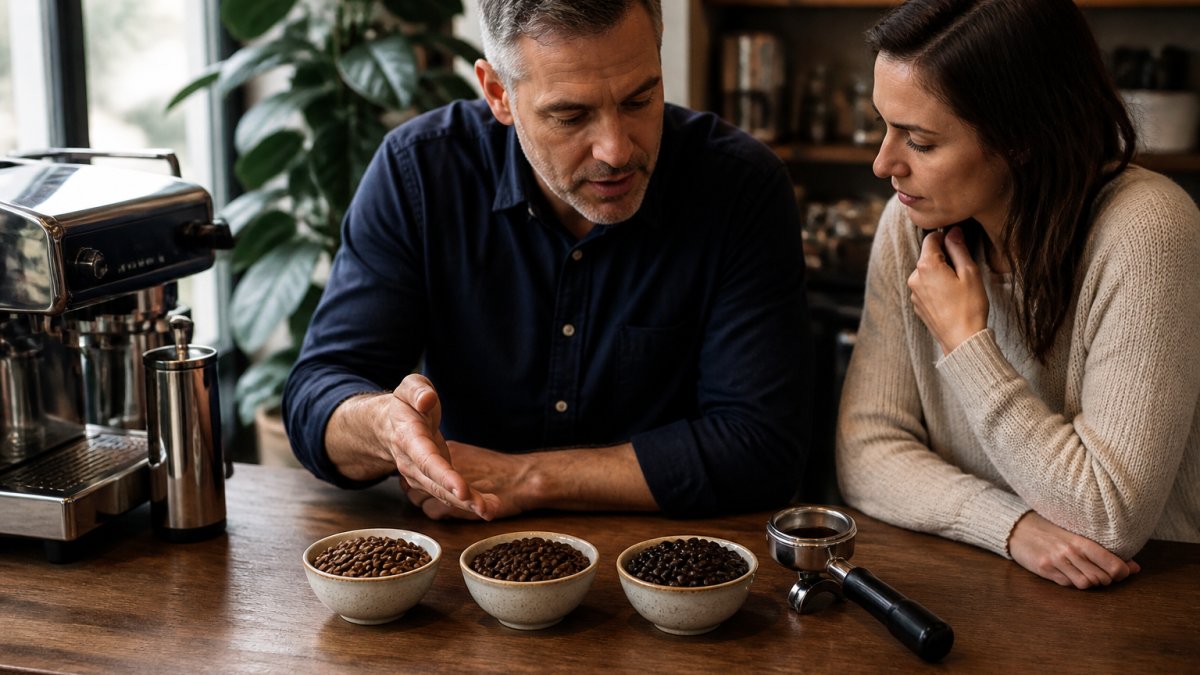
For most home setups, the best medium roast espresso beans deliver the widest margin for error. Look for beans labeled "espresso roast" or "omni roast" with tasting notes of caramel, almond, or milk chocolate. Single-origin medium roasts from Brazil or Colombia tend to be forgiving and sweet, while medium-roast espresso blends combine Arabica for sweetness with a touch of Robusta for crema and body.
What to Look for on the Bag
- A roast date, not just a best-by date
- The words "whole bean" and a resealable valve
- Tasting notes that match your preferred flavor profile
- Origin or blend composition listed clearly
- Roast level stated explicitly, not implied
Espresso Beans vs Coffee Beans: What's the Real Difference?
Espresso beans and coffee beans are the same thing: both are roasted coffee seeds. The distinction is marketing and roast intent. "Espresso beans" usually means a darker or medium-dark roast, often a blend, engineered to extract under pressure. "Coffee beans" generally refers to lighter roasts built for drip, pour-over, or French press. Any coffee bean can go in a portafilter, but a bean roasted for filter brewing may taste thin or sour as espresso. Match the roast to the brew method and the label matters far less than the roast date.
The Best Espresso Beans for Automatic Machines: Roast and Grind Guidance
Automatic espresso machines reward consistency, and medium to medium-dark roasts are the most consistent performers. Their stable density feeds evenly through built-in grinders, and they extract predictably shot after shot. Avoid very oily dark roasts in super-automatic machines; the oils gum up grinders and brew units over time. Light roasts can work, but many automatic machines max out on temperature and grind fineness before a light roast is fully extracted.
Measurable Dialing-In Parameters
Most practitioners start with a dose that fits the basket, a yield roughly double the dose in grams, and a brew time in the range of 25 to 30 seconds, then adjust grind in small steps. If shots run fast and taste sour, grind finer. If they crawl and taste bitter, grind coarser. For a full walkthrough, see our 7 steps to dial in espresso shots at home.
How Roast Level Changes the Starting Point
The same machine, dose, and yield generally behave differently across roast levels. Light roasts usually need a finer grind and a higher temperature to reach the target time; dark roasts often need a coarser grind and a slightly lower dose to avoid gushing. Medium and medium-dark roasts sit closest to the baseline and need the fewest changes, which is why they are the set-and-forget choice for automatic machines.
Commercial Use and Consistency
In a café or small office setting, batch-to-batch consistency matters more than any single bag. Medium roasts hold their profile across bags and require less grinder adjustment between services, while dark roasts drift toward bitterness as burrs heat up during volume. Check the roast date, rest beans five to fourteen days after roasting, and store them in an airtight, opaque container at room temperature. Water composition also shifts perceived acidity and bitterness across roast levels, so keep your water consistent if you want repeatable shots.
The Best Espresso Beans for Lattes and Milk Drinks
Milk mutes delicate flavors, so the best espresso beans for lattes are medium-dark or dark roasts with bold, chocolatey notes that punch through steamed milk. A medium-dark blend with caramel and cocoa notes makes a cappuccino taste like dessert. Light roasts disappear under milk unless you pull a larger, more concentrated dose. Pair your beans with solid technique: our guide to frothing milk like a barista covers texture and temperature.
Freshness, Degassing, and Storage: Getting the Most from Your Beans
Freshness beats roast level when choosing between two good bags. Coffee releases carbon dioxide for days after roasting, and that gas disrupts espresso extraction. Let beans rest five to fourteen days after the roast date before pulling shots. Store them in an airtight, opaque container at room temperature, away from light and heat. Skip the fridge and freezer for daily-use beans; condensation and odors do more harm than good.
How to Match a Roast to Your Modesto & Associates Machine
For most owners, a medium or medium-dark espresso blend is the set-and-forget answer. If you prefer lighter, fruitier shots, adjust the grind finer and give the machine a few shots to settle in. New to machine selection entirely? Read our guide to choosing a home espresso machine first. Magic2 and Royal also work in small office and bed and breakfast settings.
Frequently Asked Questions
What is the best roast of coffee beans for espresso machines?
Medium to medium-dark roasts are the most forgiving starting point for professional espresso machines. They balance sweetness, body, and acidity, and they extract consistently across a range of grind settings. Light roasts can work well but demand finer grinding and precise dialing in, while very dark roasts tend to taste bitter and ashy if the brew temperature runs high. Start with a medium roast, then adjust based on what you taste in the cup.
Are espresso beans different from regular coffee beans?
Not inherently. The difference between espresso beans vs coffee beans usually comes down to roast level and blend composition, not the bean itself. Espresso blends often combine Arabica and Robusta for extra crema and body, and they are roasted to suit high-pressure extraction. Any coffee bean can be brewed as espresso if it is ground correctly and dialed in, but blends labeled for espresso are formulated to taste balanced in a concentrated shot.
Which espresso beans work best for lattes?
For lattes, choose a medium-dark or dark roast with chocolate, caramel, or nutty tasting notes. The milk softens acidity and highlights sweetness, so a roast with a bold flavor profile holds up better than a delicate light roast. Blends with some Robusta can add extra body and crema. Avoid extremely dark, oily beans if you want the coffee to come through the milk rather than taste burnt.
How fresh should coffee beans be for espresso?
Look for a roast date on the bag and use beans between roughly 5 and 30 days after roasting. Beans need a few days to degas after roasting; using them too soon can produce uneven extraction and excess foam. After about a month, flavors flatten. Store whole beans in an airtight container away from light and heat, and grind just before brewing for the best espresso shot quality.
Choosing beans can feel endless, but roast level narrows the field fast. Modesto & Associates builds professional super-automatic espresso machines with integrated milk cooling, so you can move from bag to café-standard cup without the guesswork. Get started with Modesto & Associates and find the roast that makes your morning ritual effortless.