 how-to
Benefits of Automatic Milk Cooling Accessories
Table of Contents
- Why Automatic Milk Cooling Accessories Matter for Espresso
- How an Automatic Milk Cooler for Espresso Machine Works
- How to Keep Milk Cold for Espresso Throughout the Day
- Milk Temperature for Frothing: Why Consistency Matters
- Milk Cooler Cleaning and Maintenance Essentials
- Saving Energy, Water, and Money with Automatic Cooling
- What to Look for in Automatic Cooling Accessories
- Frequently Asked Questions
Last Updated: October 12, 2026
Why Automatic Milk Cooling Accessories Matter for Espresso
Automatic milk cooling accessories keep milk at a steady cold temperature so every espresso drink you make tastes the same, whether it is the first cup of the morning or the last one of the night.
Milk cooling is one of the most overlooked parts of home espresso. Most people focus on the machine, the beans, or the grinder.
Here is the simple truth: cold milk froths better.
Automatic cooling accessories solve a problem you may not even know you have. They remove the guesswork.
This matters because milk quality drops the moment it sits at room temperature.
Manual vs. Automatic Cooling: What Changes
Manual cooling means you handle the cold chain yourself. You pull milk from the fridge, pour it, froth it, and hope it stays cold long enough.
Automatic cooling changes the equation. The accessory holds milk at a set temperature on its own. You do not have to think about it.
- Manual: You chill, pour, and monitor by hand
- Automatic: The system holds the temperature for you
- Manual: Works fine for one drink
- Automatic: Works for a full morning of guests
- Manual: Temperature drifts as milk sits out
- Automatic: Temperature stays consistent
The difference shows up most when you make several drinks in a row. With manual cooling, the milk warms as you work.
How an Automatic Milk Cooler for Espresso Machine Works
An automatic milk cooler for espresso machine use is a refrigerated accessory that keeps milk cold and ready for frothing.
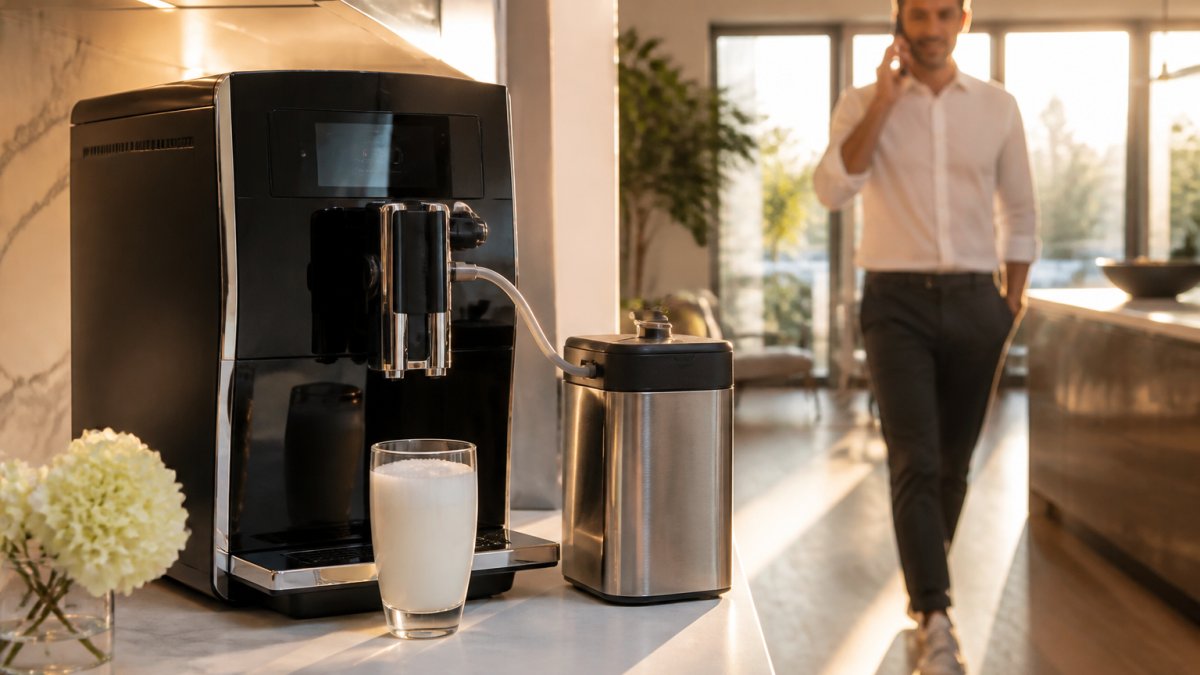
Most units rely on a few core parts working together:
- Insulated tank or container that holds the milk
- Refrigeration or chilled water loop that pulls heat out
- Temperature sensor that reads the milk temperature
- Temperature control that adjusts cooling as needed
- Agitator that keeps the milk moving so it cools evenly
The science is simple. Heat transfer moves warmth out of the milk and into a colder medium. A plate cooler or chilled water loop does this fast.
That feedback loop is what makes it automatic. You set it, and it holds.
How to Keep Milk Cold for Espresso Throughout the Day
The best way to keep milk cold for espresso is to store it at a steady refrigerated temperature and never let it sit out between drinks.
If you are working without an automatic system, a few habits help:
- Keep milk in the fridge until the moment you need it
- Pour only what you will use in one session
- Return the carton to the fridge right away
- Use a small insulated pitcher for short sessions
- Never leave milk on the counter between drinks
Temperature consistency is the goal. Milk that swings between cold and warm froths unevenly. One drink comes out perfect, the next comes out thin.
For households that make several drinks a day, an automatic cooler removes the need to babysit the milk.
Here is a quick reference for how storage choices affect your results:
| Storage Method | Temperature Hold | Best For | Effort |
|---|---|---|---|
| Counter pitcher | Poor | One quick drink | High |
| Fridge between pours | Good | Occasional use | Medium |
| Insulated pitcher | Fair | Short sessions | Medium |
| Automatic cooler | Excellent | Daily, multiple drinks | Low |
Milk Temperature for Frothing: Why Consistency Matters
Milk temperature for frothing decides how well the milk foams and how the final drink tastes. Cold milk gives you more time to build foam before it scalds.
The reason comes down to how milk proteins behave. Cold milk holds its structure longer as steam and air enter it.
Consistency is what separates a good home setup from a frustrating one. If the milk temperature changes every time, your drinks change too.
This is also where an automatic milk cooler for espresso machine setups earns its keep. It keeps the milk at the right temperature so you never have to guess.
Milk Cooler Cleaning and Maintenance Essentials
Milk cooler cleaning and maintenance keep your accessory working and your milk safe.
A simple routine covers most of it:
- Rinse the milk lines and tank after each use
- Wash removable parts with warm soapy water daily
- Run a deeper clean of the lines weekly
- Check the temperature sensor for buildup
- Inspect seals and gaskets for cracks
- Descale or service the cooling unit as the manual directs
The FDA guidance on safe food handling and storage stresses keeping dairy equipment clean to limit bacterial growth.
What most guides miss is the milk line. Residue hides inside tubing where you cannot see it.
Cold weather and summer operation both affect how hard the unit works. In summer, the system runs more to hold temperature. In cold weather, it may run less.
Saving Energy, Water, and Money with Automatic Cooling
Automatic cooling can cut energy costs, water use, and waste when it is set up well.
Where the savings actually come from:
- Right-sized cooling: A sensor-based unit runs the compressor only when milk temperature rises above the setpoint. A timer-based unit runs on a fixed schedule whether the tank is full or nearly empty, so it cycles more often than needed.
- Less compressor cycling: Short, frequent compressor starts draw more current than longer, steadier runs. A unit with a real thermostat and a small tank of cold milk tends to run more efficiently than one that lets milk warm up and then blasts it cold again.
- Water reuse: Some chilled-water loops recirculate the same water through the cooling circuit instead of running fresh water to drain. That cuts water use, but recirculated water needs periodic treatment or replacement to stay sanitary.
- Less milk waste: Cold milk lasts longer and froths better, so fewer pitchers are poured out. The biggest hidden cost in home espresso is the drink you throw away because the milk warmed up or the froth collapsed.
- Labor savings: No more checking the fridge, the clock, or the pitcher temperature between drinks. That time adds up over a week of daily use.
A simple way to think about payback: track how much milk you pour out in a typical week, then compare that to the cost of the accessory.
For small offices and bed and breakfast kitchens, the math is even clearer. More drinks per day means more chances for milk to warm up and spoil.
One trade-off worth noting: an automatic cooler uses electricity continuously to hold temperature, while a manual routine uses none between drinks. The automatic unit wins on consistency and waste, but if you make only one drink a day, the energy cost may not pay back. The break-even point is usually several drinks per day, not one.
What to Look for in Automatic Cooling Accessories
The right automatic cooling accessory depends on your machine, your space, and how many drinks you make. Focus on compatibility, temperature control, and easy cleaning first. This is the part most guides skip: matching the accessory to your existing equipment and getting it installed and calibrated correctly.
Compatibility: Match the Accessory to Your Setup
Before you buy, check these points against your machine and kitchen:
- Machine interface: Does the accessory connect to your espresso machine's milk line, or does it sit beside it as a standalone chiller? Integrated units need a compatible fitting; standalone units need counter space and a power outlet.
- Tank capacity: Match capacity to daily milk use. A tank that is too large takes longer to chill and holds milk longer than you may use it. A tank that is too small runs out mid-service.
- Power supply: Check the voltage and amperage the unit draws against your outlet and circuit. A dedicated circuit is safer for a unit that runs continuously.
- Footprint and clearance: Leave room for airflow around the compressor. A unit boxed in against a wall runs hotter and works harder.
- Cleaning access: Can you remove the tank, lines, and seals without tools? If not, cleaning becomes a chore and gets skipped.
- Support and parts: Can you get replacement seals, sensors, and lines? A unit with no parts support becomes disposable when a small part fails.
Installation and Setup
Installation is usually straightforward, but a few steps matter:
- Place the unit on a level surface with clearance for airflow and access to the power outlet.
- Connect the milk line if the unit feeds your machine. Use food-grade tubing and secure fittings to prevent leaks and air pockets.
- Fill the tank to the recommended level. Overfilling can block the agitator; underfilling can make the sensor read air instead of milk.
- Power on and let it chill to the setpoint before adding milk for service. Most units need time to bring the tank and lines down to temperature.
- Calibrate the sensor if the unit allows it. Compare the displayed temperature against an independent thermometer in the milk and adjust if needed.
- Run a test session with water first to check for leaks, then with milk to confirm the temperature holds through several drinks.
Temperature Control: Sensor vs. Timer
Temperature monitoring is the feature worth paying attention to. A real sensor keeps the milk steady by adjusting to how much milk is in the tank. A timer-based system guesses based on a fixed schedule. For daily use, the sensor wins. Look for a unit that displays the actual milk temperature, not just a setpoint, so you can verify it is holding.
Cleaning and Maintenance Access
Choose a unit you can clean without disconnecting everything. Removable tanks, quick-release lines, and accessible seals make the daily rinse and weekly deep clean realistic.
At Modesto & Associates, our super-automatic espresso machines pair with integrated milk cooling solutions so the temperature stays right without extra steps. If you want café-standard drinks at home without the fuss, that pairing is where it starts.
Frequently Asked Questions
What does an automatic milk cooling accessory do?
An automatic milk cooling accessory keeps milk at a consistent cold temperature between espresso drinks. It uses a refrigeration unit or chilled water system to maintain safe storage temperatures, reducing bacterial growth and preserving freshness. This means you can froth milk for multiple drinks without repeatedly opening the refrigerator or worrying about spoilage. It also ensures every latte or cappuccino gets milk at the ideal temperature for consistent froth.
How does a milk cooler work with a super-automatic espresso machine?
A milk cooler connects to your espresso machine's milk intake line, delivering cold milk directly to the frothing mechanism. The cooling unit maintains a steady temperature, so the milk stays fresh and ready for frothing. This integration eliminates the need to manually pour milk from a carton each time. Many automatic milk coolers for espresso machines are designed to fit compactly alongside the machine, making them ideal for home kitchens and small offices.
Does a milk cooler improve milk froth quality?
Yes. Cold milk froths more easily and produces a denser, creamier microfoam because the proteins and fats are stable at lower temperatures. When milk warms up, it can froth inconsistently or become too airy. An automatic milk cooler maintains the ideal milk temperature for frothing, so you get barista-quality texture in every drink. Consistent temperature also means you can repeat the same froth result drink after drink.
How should you clean an automatic milk cooling accessory?
Most automatic milk cooling accessories have removable parts that should be rinsed daily with warm water and a mild detergent. The milk lines and nozzles need weekly deep cleaning to prevent residue buildup and bacterial growth. Some units offer automatic rinse cycles. Always follow the manufacturer's instructions for specific cleaning schedules. Regular milk cooler cleaning and maintenance keeps the system hygienic, extends its lifespan, and ensures your milk tastes fresh.
Making great milk drinks at home comes down to one thing: control. When the milk stays cold and consistent, everything else gets easier. Modesto & Associates offers professional super-automatic espresso machines with integrated milk cooling solutions, built for barista-quality coffee at home. Our setup handles the temperature so you can focus on the drink. Shop Magic M2+ and see how simple a great cup can be.