 how-to
Can You Use Pre Ground Coffee in Super Automatic?
Table of Contents
- Can You Use Pre Ground Coffee in Super Automatic Machines?
- Step-by-Step: Using the Super Automatic Espresso Machine Bypass Chute
- Grind Size and Dose Weight: Why Pre Ground Coffee Struggles
- Best Coffee Beans for Super Automatic Machines (and When Pre Ground Makes Sense)
- How to Clean Super Automatic Espresso Machine After Pre Ground Coffee
- Decaf, Flavored, and Switching Between Pre Ground and Whole Bean
- Common Mistakes and Troubleshooting Watery Espresso
- Frequently Asked Questions
Last Updated: October 4, 2026
Can You Use Pre Ground Coffee in Super Automatic Machines?
Yes, you can use pre ground coffee in a super automatic machine, but only through the bypass doser.
This guide from Modesto & Associates covers exactly how that works.
The bypass doser is the key. It is a separate funnel on your machine that accepts coffee you grind yourself or buy pre ground.
But there's a catch. Pre ground coffee doesn't behave like fresh beans. The grind may be too fine or too coarse.
Below, we'll walk through the full process, from loading the chute to cleaning up after.
How the Bypass Doser Works
The bypass doser is a second coffee path inside your machine. It feeds pre ground coffee straight to the brew group, past the grinder.
On most super automatic espresso machines, you'll find it as a small hatch on top.
Here's what happens next:
- The machine detects coffee in the chute
- It skips the grinder cycle
- The brew group pulls the pre ground coffee into the puck
- Water runs through at your selected pressure and volume
The system is simple by design. It exists so you can brew a single cup that's different from your hopper beans.
One thing to know: the bypass doser handles one shot at a time. You can't fill it and walk away. Each cup needs a fresh scoop.
What Pre Ground Coffee Cannot Do
Pre ground coffee cannot match the freshness, aroma, or crema of beans ground seconds before brewing. That's the honest trade-off.
Coffee starts losing its oils and aroma soon after grinding. The finer the grind, the faster it fades. By the time pre ground coffee sits in a bag or a scoop, much of what makes espresso taste alive is gone.
So expect a few differences:
- Thinner crema
- Less aroma
- Flatter flavor profile
- Faster staling once opened
None of this makes pre ground coffee useless. It just means you're trading peak quality for convenience. For a decaf nightcap or a flavored treat, that's often a fair deal.
Step-by-Step: Using the Super Automatic Espresso Machine Bypass Chute
Using the bypass chute takes about a minute. The steps are the same across most super automatic machines, though button names vary.
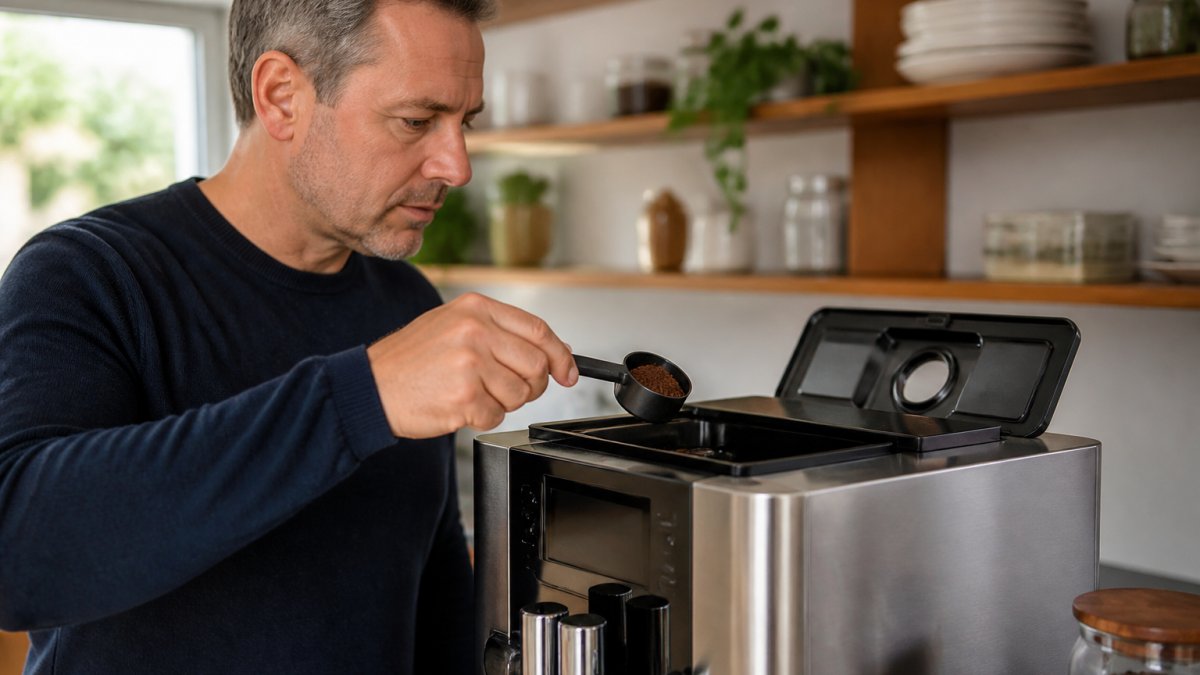
- Warm up the machine. Let it run its rinse cycle so the brew group reaches temperature.
- Find the bypass chute. It's usually a small lid or hatch on top, separate from the bean hopper.
- Measure one dose. Use the dosing scoop that came with your machine. One level scoop per shot.
- Pour it in. Tip the coffee into the chute. Don't tamp it down or pack it.
- Close the lid. The machine needs the hatch shut to run the cycle.
- Select the bypass option. Choose "pre ground" or "bypass" on the display, then pick your drink.
- Start the brew. The machine skips the grinder and pulls your shot.
- Empty and rinse. Clear any leftover grounds from the chute right away.
Skip step eight and you'll regret it. Leftover grounds cake up and block the next cycle.
Grind Size and Dose Weight: Why Pre Ground Coffee Struggles
Grind size decides how fast water moves through the coffee. Super automatic machines are tuned for one specific grind from their internal grinder. Pre ground coffee rarely matches it.
If your pre ground coffee is too fine, water struggles to pass through. The shot runs slow, tastes bitter, and can clog the brew group.
Espresso needs a fine grind, but "fine" has a narrow window. Most store-bought pre ground coffee is ground for drip makers, which is coarser than espresso needs.
The Grind Consistency vs. Machine Pressure Problem
Your machine's pressure pump pushes water at a set pressure, typically in the 9 to 15 bar range depending on the model.
Drip grind particles are sized for a gravity-fed brewer that pushes water at well under 2 bar.
Espresso grind, by contrast, is sized so the puck creates enough resistance to hold the pump back for 25 to 30 seconds.
Whole beans ground fresh give you control. You can adjust the grind setting until the shot time lands in range. With pre ground, you adjust everything else around a fixed variable.
A Quick Diagnostic: The Shot-Time Test
You can tell whether your pre ground coffee is close to espresso range without any special tools. Pull a single shot and time it from the moment the pump starts to the moment it stops.
- Under 15 seconds: grind is too coarse. The puck isn't resisting the pump.
- 15 to 20 seconds: borderline. Drinkable, but likely thin.
- 20 to 30 seconds: in range. This is where espresso should land.
- Over 35 seconds: grind is too fine. Risk of clogging the brew group.
If your shot runs under 15 seconds, switch to a pre ground coffee labeled "espresso grind." If it runs over 35 seconds, back off the dose or switch to a slightly coarser bag. There is no grind dial on a bag of pre ground, so the bag itself is your only lever.
How Much Coffee Per Shot?
A standard single shot uses about 7 to 9 grams of coffee. A double shot runs closer to 14 to 18 grams. Your dosing scoop is usually sized for one of these.
Weigh your dose if you want consistency. A small kitchen scale removes the guesswork. Level scoops vary a lot depending on how you pack them, and a scoop that looks level can swing by 2 to 3 grams depending on grind fineness.
Too little coffee and the shot runs watery. Too much and the brew group strains or leaks.
| Shot Type | Coffee Dose | Water Yield | Best For |
|---|---|---|---|
| Single | 7-9 g | 25-30 ml | Quick pick-me-up |
| Double | 14-18 g | 50-60 ml | Milk drinks |
| Ristretto | 7-9 g | 15-20 ml | Bold, syrupy shots |
Why Uneven Particles Matter More Than Average Grind
Two bags of pre ground coffee can have the same average particle size and still behave differently. What matters is the spread. A bag with a wide range of particle sizes lets water find the easy path through the coarse bits while the fine bits over-extract.
This is why commercial espresso grinders use burr sets that produce a narrow particle distribution. Pre ground coffee from a grocery shelf is usually ground on a blade or bulk burr grinder with a much wider spread. You can't fix that at home.
Best Coffee Beans for Super Automatic Machines (and When Pre Ground Makes Sense)
The best coffee beans for super automatic machines are medium roasts with a consistent, even color. They feed smoothly through the grinder and produce balanced shots.
Here's what to look for:
- Medium roast level for balanced flavor
- No oily or flavored coatings on the beans
- Fresh roast date, ideally within a few weeks
- Uniform bean size for even grinding
Dark, oily beans can gum up the grinder. Flavored beans leave residue that taints every later cup.
So when does pre ground coffee make sense? A few clear cases:
- You want decaf for one cup without a second hopper
- A guest asks for a flavored coffee you don't keep on hand
- You're testing a new roast before committing to a bag
- Your grinder is off for cleaning
For daily brewing, whole beans win. The bypass chute is a tool for exceptions, not your main routine.
How to Clean Super Automatic Espresso Machine After Pre Ground Coffee
Cleaning after pre ground coffee matters more than after whole beans. Loose grounds scatter, and residue builds fast.
Start with the bypass chute itself. Wipe it out after every use. A dry paper towel or a soft brush clears the leftover dust.
Daily Rinse and Weekly Deep Clean
Daily, run your machine's rinse cycle and empty the drip tray. Check the chute for stray grounds.
Weekly, do a deeper pass:
- Remove and rinse the brew group if your model allows
- Wipe the chute and surrounding area
- Run the machine's cleaning program
- Descale on the schedule your manual recommends
Pre ground coffee leaves more residue than beans, so don't stretch the intervals. Stick to the routine and your machine stays healthy.
Decaf, Flavored, and Switching Between Pre Ground and Whole Bean
Switching between pre ground and whole bean is easy, but you need to flush the path between them. Otherwise flavors and oils cross-contaminate.
If you brew a flavored pre ground coffee, run a blank shot afterward. This rinses the brew group so your next regular espresso tastes clean.
For decaf, the same rule applies. Decaf oils can linger and slightly mute your next caffeinated shot.
A simple switching routine:
- Finish your pre ground shot
- Empty and wipe the bypass chute
- Run a blank water cycle
- Return to your hopper beans
This keeps flavors separate and your machine clean. It also protects the internal sensors from residue buildup over time.
Common Mistakes and Troubleshooting Watery Espresso
Watery espresso is the most common complaint with pre ground coffee. The cause is usually one of three things: grind too coarse, dose too small, or a clogged path.
Work through the fixes in order:
- Grind too coarse: switch to an espresso-ground coffee
- Dose too small: weigh your scoop and aim for 7-9 grams
- Clogged chute: clear leftover grounds and rinse
- Worn brew group: run the cleaning cycle
- Old coffee: open a fresh bag
If the shot still runs weak, check your machine's settings. Some models let you adjust pre-infusion and shot volume.
The bigger point: pre ground coffee gives you less control. You can't dial the grind. You can only adjust dose, volume, and freshness. Set expectations accordingly.
At Modesto & Associates, we build our machines around barista-quality results at home. The bypass chute is one tool in that system, and knowing its limits helps you get the most from every cup.
Pre ground coffee has real limits, and a machine that fights those limits wastes your time and money.
Frequently Asked Questions
Will pre ground coffee damage my super-automatic machine?
Pre ground coffee won't damage the machine if you use the bypass chute, which skips the internal grinder. The real risks are clogging and residue buildup. Fine pre ground coffee can block the brew group and leave oils that affect future shots. Clean the brew group and chute after each use to prevent problems.
What grind size should I use for pre ground coffee in a super automatic?
Use an espresso-ground consistency, similar to table salt. Too fine and the machine may clog or produce bitter, over-extracted shots. Too coarse and water flows through too fast, giving you watery coffee with weak flavor. If you're buying pre ground, look for bags labeled 'espresso grind' rather than 'drip' or 'French press.'
Can I use flavored pre ground coffee in my super automatic?
Yes, but only through the bypass chute. Flavored coffees often contain oils and syrups that leave residue in the internal grinder and brew group. Those residues can cause cross-contamination, meaning your next plain shot tastes like hazelnut or vanilla. Clean the chute and brew group immediately after using flavored coffee.
How do I clean my super automatic espresso machine after using pre ground coffee?
Run a rinse cycle immediately after your shot to flush loose grounds. Weekly, remove the brew group and rinse it under warm water, then let it air dry. Use the machine's built-in cleaning program monthly. If you notice clogging or weak flow, check the bypass chute for compacted grounds and clear them with a soft brush.