 listicle
Is a Home Coffee Station Worth It? A 2026 Review
Table of Contents
- The Real Cost of a Home Coffee Station vs. Daily Coffee Shop Runs
- Essential Home Coffee Station Equipment for a Barista-Quality Setup
- How to Design a Small Coffee Nook in Any Kitchen
- The Hidden Costs: Maintenance, Cleaning, and Electrical Needs
- Ergonomics and Workflow: Designing for Morning Efficiency
- Is a Home Coffee Station Worth It for Casual Drinkers?
- Conclusion: Building a Coffee Setup That Works for You
- Frequently Asked Questions
Last Updated: September 24, 2026
The Real Cost of a Home Coffee Station vs. Daily Coffee Shop Runs
Is a home coffee station worth it? For most daily coffee drinkers, yes, though the payoff depends on how much you currently spend at cafés and how many people in the house drink from the same setup. A home coffee station is a dedicated countertop setup, cart, or nook where you store, grind, brew, and finish coffee drinks without leaving your kitchen. This guide breaks down the real numbers, the equipment that matters, and the hidden costs nobody mentions.
Most articles on this topic stop at the aesthetics. The honest answer lives in a cost-benefit analysis, so start there.
The café baseline. A daily café latte runs about five dollars in most cities, so a weekday habit lands near $1,300 a year before tips and pastries. Add a second household drinker and the same habit clears $2,500. That is the number your home setup is competing against, not the price of a bag of beans.
The home setup, line by line. A realistic mid-range build breaks down roughly like this:
| Line Item | Typical Upfront Cost | Ongoing Cost |
|---|---|---|
| Burr grinder | $150-$200 | None for years |
| Brewing method (drip or pod) | $100-$250 | Pods run $0.75-$1.25 each |
| Super-automatic espresso machine | Pricing depends on quantity, dates, and delivery | Beans, milk, cleaning supplies |
| Precision scale | $20-$150 | None |
| Airtight canisters | $15-$40 | None |
| Water filter (if used) | $20-$50 | $30-$80 per year |
| Descaling and cleaning supplies | $25-$60 | $40-$100 per year |
Beans run roughly $12 to $20 per pound. A daily drinker using about a pound every ten days spends roughly $500 to $750 a year on beans. Milk, oat milk, and syrups add another $100 to $300 depending on drink style.
The break-even math. A daily café drinker spending $1,300 a year against a $900 mid-range setup plus $650 in annual consumables breaks even in roughly 16 to 20 months. Swap in a super-automatic at $1,500 and the same math stretches to about two years, but the machine replaces the drinks you would otherwise buy most often, including milk drinks, so the per-drink savings are larger. Two daily drinkers in one household cut every one of those timelines roughly in half.
Bureau of Labor Statistics Consumer Expenditure Survey tracks household food-away-from-home spending, and coffee is one of the steadiest line items. That consistency is exactly why the break-even math works.
The time side of the ledger. Money is only half the calculation. A café run costs 10 to 20 minutes of travel, parking, and waiting on top of the drink price. A home station compresses that to two to four minutes once the workflow is dialed in. For a daily drinker, that is 40 to 80 hours a year returned to the morning.
When the math does not work. If you drink coffee fewer than four days a week, or you genuinely enjoy the café ritual and the walk, the savings evaporate. A pod system at $0.75 to $1.25 per cup is not meaningfully cheaper than a $3 drip coffee, and the convenience premium you paid for the machine never gets repaid. Be honest about which drinker you are before you spend.
Essential Home Coffee Station Equipment for a Barista-Quality Setup
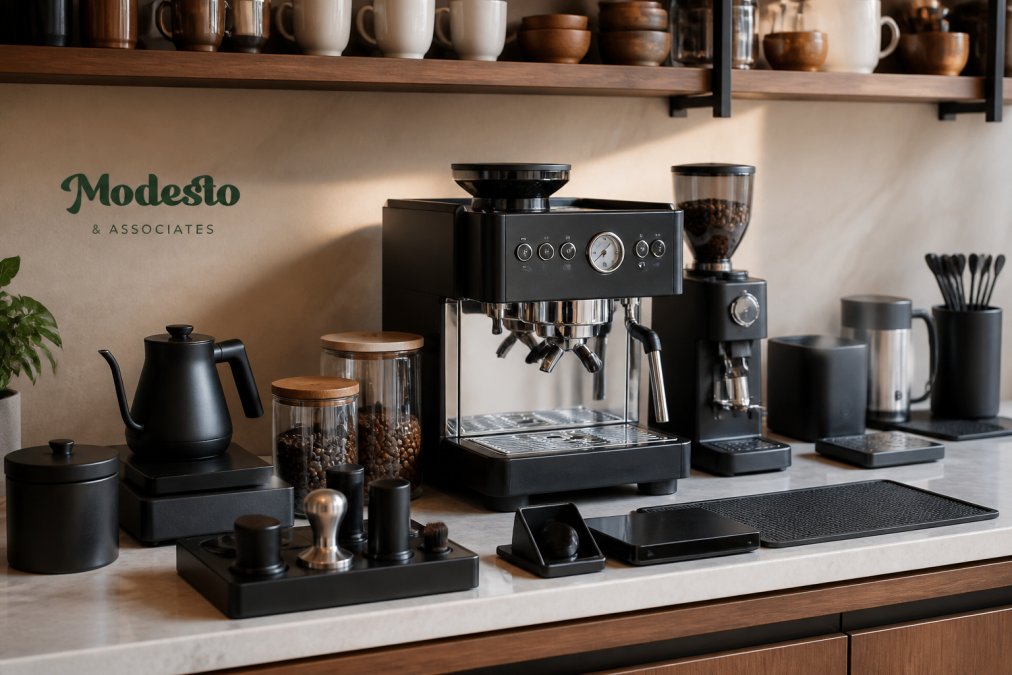
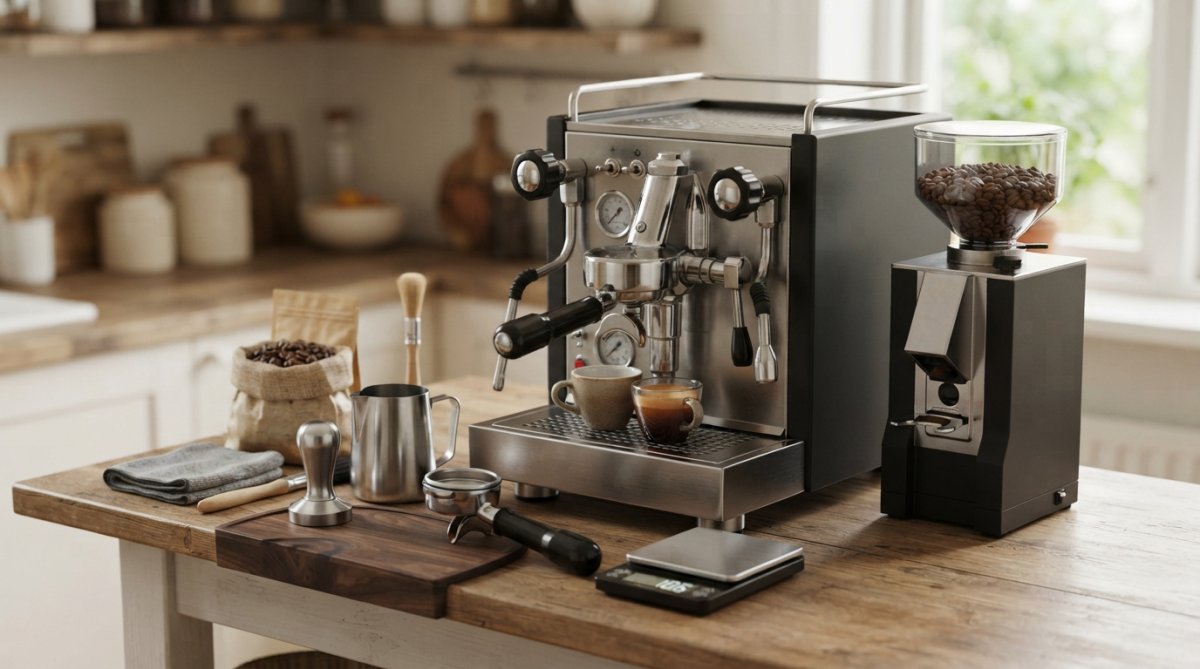
A barista-quality setup needs four things: a grinder, a brewing method, a scale, and storage that keeps beans fresh. Everything else is preference.
Here is the core equipment list and what each piece actually does:
| Equipment | Why It Matters | Example |
|---|---|---|
| Burr grinder | Consistent particle size controls extraction | Baratza Encore Conical Burr Grinder |
| Brewing method | Determines drink style and effort | Super-automatic espresso machine, drip brewer, or pod system |
| Precision scale | Tracks dose and yield for repeatable shots | Acaia Pearl Coffee Scale |
| Airtight canisters | Preserve freshness and reduce counter clutter | Vacuum-sealed bean storage |
A common mistake is spending the budget on the machine and using a blade grinder. Uneven grounds produce sour or bitter cups no machine can fix.
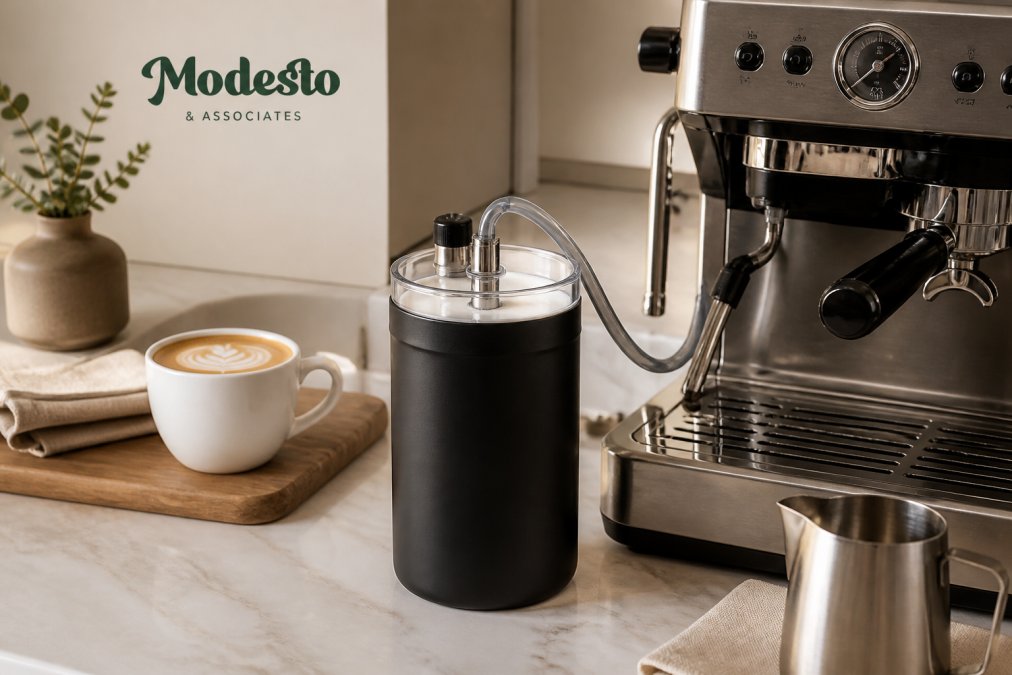
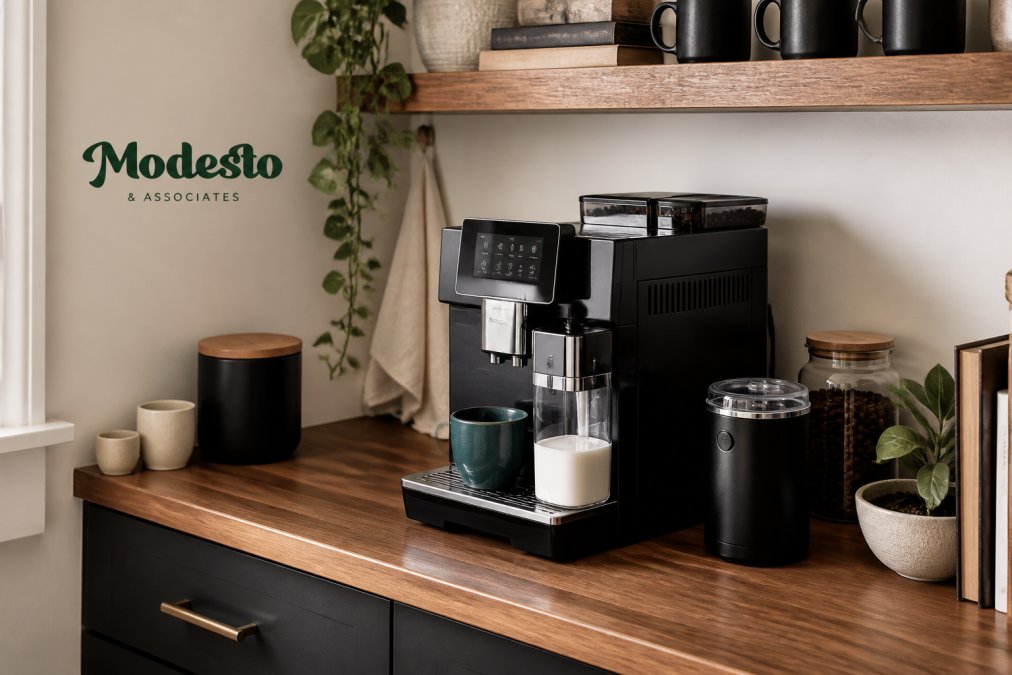
For drip drinkers, the OXO Brew 9-Cup Coffee Maker and Ratio Six both deliver consistent results, while the Ninja 12-Cup Programmable Brewer covers budget needs. Pod users get speed from the Nespresso VertuoPlus, though the proprietary capsules add up over time. If you want minimal effort and café-standard milk drinks, a super-automatic machine with an integrated milk cooling accessory handles grinding, brewing, and texturing in one step.
How to Design a Small Coffee Nook in Any Kitchen
A small coffee nook works when you claim 60 to 90 centimeters of counter space, or a rolling cart if no counter exists. Measure your kitchen layout first, then pick one vertical zone for the machine and one drawer or shelf for supplies.
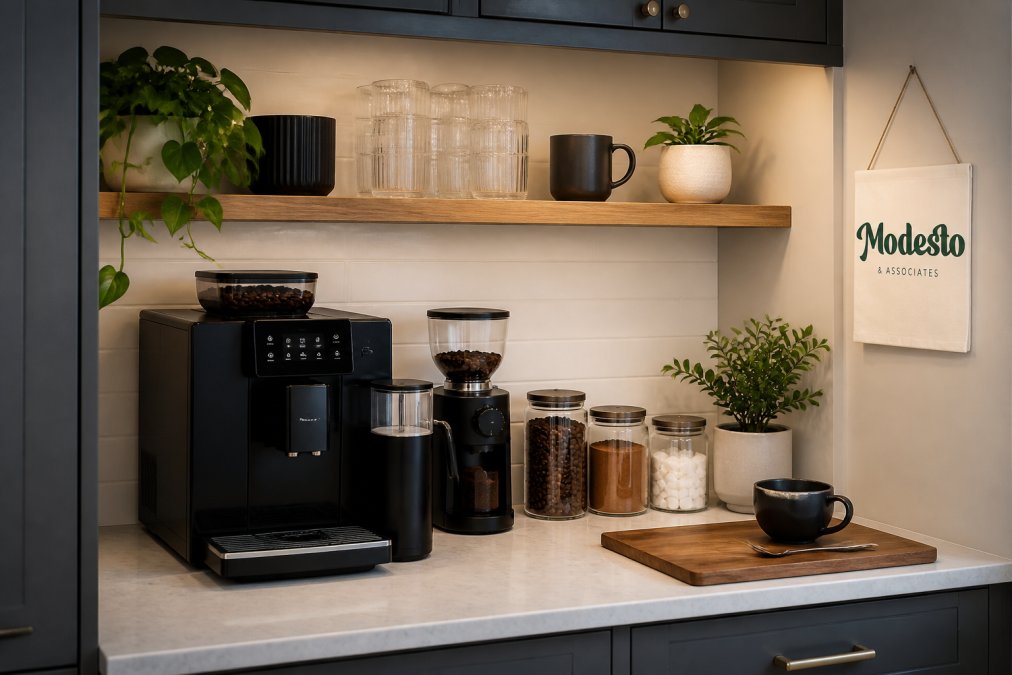
Follow these steps to design a small coffee nook:
- Measure countertop space and note nearby outlets
- Choose a cart or cabinet if counter space is tight
- Place the machine at the back, cups and beans in front
- Add one vertical shelf for mugs and canisters
- Route cords behind the machine to reduce clutter
- Confirm the outlet can handle the machine's draw
The Hidden Costs: Maintenance, Cleaning, and Electrical Needs
The purchase price is not the full cost. Descaling, filter replacements, milk system cleaning, and electricity add up, and skipping them shortens machine life.
Maintenance and cleaning requirements:
- Descaling every 2 to 3 months in hard water areas
- Daily rinse of milk lines if you use a cooling accessory
- Weekly deep clean of drip trays and brew groups
- Filter replacement per the manufacturer's schedule
Electrical and plumbing considerations:
- Most super-automatic machines draw 1,200 to 1,500 watts and need a dedicated circuit or an outlet that is not shared with a microwave
- Check whether your model needs a direct water line or a refillable tank
- Avoid extension cords for high-wattage appliances
Ergonomics and Workflow: Designing for Morning Efficiency
Workflow efficiency comes down to reach and sequence. The best coffee stations let you grind, brew, and finish a drink without moving your feet, and the layout principle that makes this work is the same one commercial baristas use.
- Grinder on the left, at counter height, with beans stored directly above or beside it
- Machine in the center, with the drip tray and brew head at chest height so you are not bending to load a portafilter or refill a tank
- Finishing zone on the right, cups, milk, syrups, spoons, and a small towel, within one reach of the machine's spout
Is a Home Coffee Station Worth It for Casual Drinkers?
For casual drinkers, a home coffee station is worth it only if you drink coffee at least four days a week. Below that, a simple drip brewer or pod system covers your needs without the maintenance overhead.
Cost-benefit analysis breaks into three groups:
| Drinker Type | Best Setup | Payback |
|---|---|---|
| Daily café buyer | Super-automatic with milk cooling | Payback depends on individual spending habits and machine pricing |
| Weekend drinker | Drip brewer or pod system | 1 to 2 years |
| Occasional guest host | Cart with drip brewer | Convenience, not savings |
Conclusion: Building a Coffee Setup That Works for You
The honest answer is that a home coffee station pays off when your habits match the equipment. Daily drinkers save money and time; occasional drinkers gain convenience. Either way, the setup should fit your kitchen, your routine, and your tolerance for cleaning.
Frequently Asked Questions
Do you actually save money making coffee at home?
Yes, over time. While a home coffee station requires an upfront investment in equipment, the cost per cup drops significantly compared to daily cafe visits. Brewing at home can cost less than $1 per cup. If you spend $5 daily at a coffee shop, the machine can pay for itself over time, making a home coffee station worth it for regular drinkers.
What are the essential components of a professional-grade home coffee setup?
A quality grinder is the most important element, which ensures consistent extraction. You also need a reliable brewing method, like a drip brewer or a super-automatic espresso machine for convenience. Add a precision scale for accuracy. These essentials form the core of any home coffee station. Modesto & Associates specializes in professional-grade, super-automatic espresso machines and high-quality milk cooling accessories designed to elevate your daily coffee ritual.
How much space do you really need for a functional coffee nook?
You can build a functional coffee nook in as little as 24 inches of counter width. Focus on vertical storage with shelves for canisters and accessories, and choose compact equipment like the Nespresso VertuoPlus or a small burr grinder. A dedicated cart or a corner of your kitchen layout can work well. The key is organizing your coffee accessories and supplies to minimize counter clutter and keep your morning routine efficient.
Is a home coffee station worth the investment for casual drinkers?
For casual drinkers who have one cup a day, a simple drip maker may be sufficient and still save money over cafe visits. However, if you enjoy espresso drinks or entertaining, a super-automatic machine from Modesto & Associates can elevate your daily ritual and offer cafe-standard beverages with minimal effort. The value depends on how often you drink coffee and your preference for convenience versus manual brewing.
Most people stall on the same question: which machine actually fits their counter and their morning. Modesto & Associates makes that decision simple with barista-quality equipment, automated preparation, and milk cooling built in. Get started with Modesto & Associates and enjoy café-standard coffee at home every morning.