 listicle
How to Buy a Professional Grade Home Espresso Machine
Table of Contents
- Why Your Kitchen Might Need a Professional Grade Espresso Machine
- Prosumer vs. Commercial Espresso Machines: What's the Real Difference?
- How to Choose a Home Espresso Machine: The 5 Specs That Matter Most
- Super-Automatic vs. Semi-Automatic Espresso Machines: Which Fits Your Routine?
- The Real Cost of Ownership: Budgeting for Installation and Maintenance
- Essential Barista Accessories for Home That Make a Difference
- Final Verdict: Matching the Machine to Your Counter and Coffee Habits
- Frequently Asked Questions
Last Updated: September 6, 2026
Buying a professional grade home espresso machine is a significant investment, and the gap between a capable home unit and a true commercial workhorse is wider than most buyers realize. If you are weighing whether to buy professional grade home espresso machine options for your kitchen, the decision hinges on your daily routine, your counter space, and your tolerance for maintenance, not just the sticker price. The most common mistake shoppers make is fixating on brew pressure while ignoring the electrical and plumbing realities of their own home. Below, we break down the specifications that actually matter, the true cost of ownership, and how to match a machine to your counter and your coffee habits.
Why Your Kitchen Might Need a Professional Grade Espresso Machine
The case for professional-grade equipment at home starts with consistency. A prosumer espresso machine with a dual boiler or a heat exchanger delivers stable thermal performance shot after shot, which is the difference between a morning ritual and a frustrating gamble. If you regularly host guests or you are simply tired of paying café prices for drinks you could replicate at home, the convenience of immediate, barista-quality output changes your daily economics.
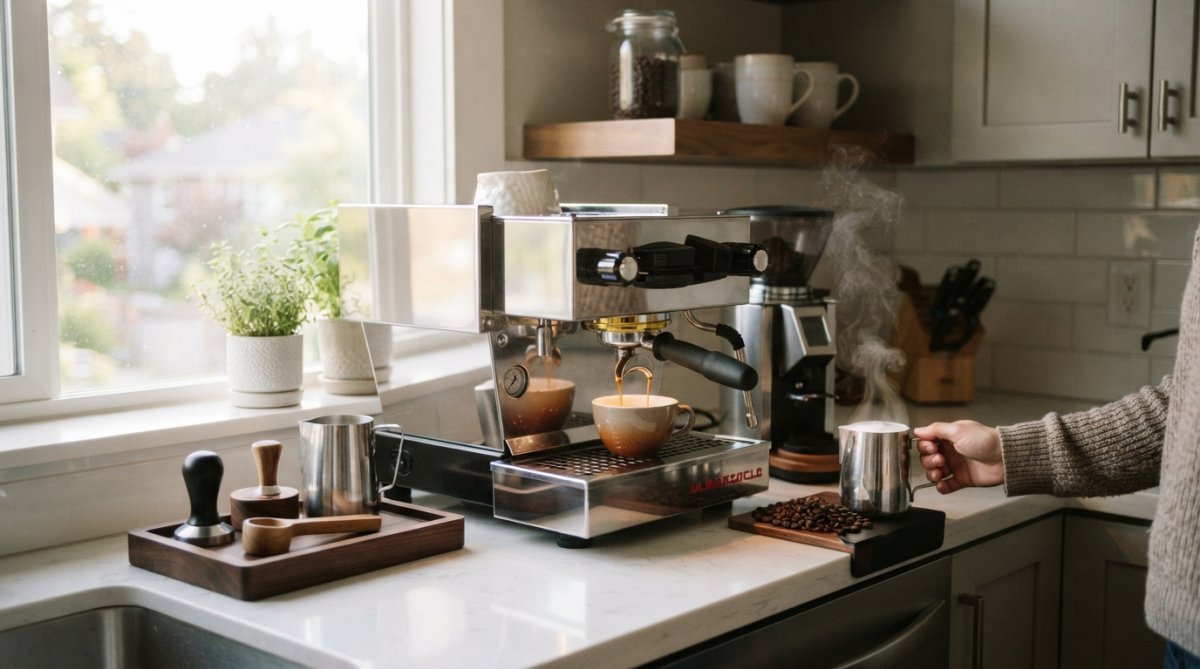
The real shift happens when you consider the alternative. Many households find that the cumulative cost of daily coffee shop visits justifies a serious machine within a couple of years. A professional-grade unit also holds its value better than entry-level appliances, and its stainless steel construction and commercial-grade components are designed for a decade or more of service rather than a few years of moderate use.
Prosumer vs. Commercial Espresso Machines: What's the Real Difference?
A prosumer espresso machine is built to commercial standards but scaled for home use, while a true commercial machine is designed for continuous, high-volume operation in a café setting (home-barista.com). The distinction matters because commercial units often require a 220-volt electrical circuit and a plumbed-in water supply, both of which are rare in standard home kitchens. Prosumer models, by contrast, operate on a standard 110-volt outlet with a water reservoir, making them practical for most households.
The internal components tell the rest of the story. Commercial machines use rotary pumps that run quietly and can draw from a direct water line, while many prosumer models use vibratory pumps that pull from a reservoir. Both can produce excellent espresso, but the rotary pump's quiet operation and ability to support plumbing make it the preferred choice for serious home setups. The E61 group head, found on many prosumer machines, provides thermal stability through its massive brass construction, though it requires a longer heat-up time.
How to Choose a Home Espresso Machine: The 5 Specs That Matter Most
Choosing the right home espresso machine comes down to five specifications that separate a capable machine from a frustrating one. Thermal stability is the foundation; a dual boiler or a heat exchanger with PID temperature control keeps water at the exact temperature needed for proper extraction. Boiler capacity determines whether you can brew and steam simultaneously, which is essential if you regularly make milk-based drinks.
The pump type affects noise and installation flexibility, with rotary pumps offering quieter operation and plumbing options. Group head design influences temperature consistency, with the E61 design being the industry standard for thermal stability. Finally, pressure profiling and flow control allow advanced users to manipulate the extraction curve, though this feature adds complexity and cost that many home users never fully use.
Super-Automatic vs. Semi-Automatic Espresso Machines: Which Fits Your Routine?
The choice between super-automatic and semi-automatic machines is really a question of how much hands-on involvement you want each morning. A semi-automatic machine requires you to grind, dose, tamp, and manually control the shot, offering maximum control for enthusiasts who enjoy the craft. A super-automatic machine handles grinding, dosing, tamping, and extraction at the touch of a button, trading control for convenience.
For busy professionals who want café-standard beverages without the learning curve, super-automatic machines are the practical answer. For busy professionals who want café-standard beverages without the learning curve, super-automatic machines are the practical answer. These machines deliver consistent results with minimal effort, making them ideal for households where the machine must work reliably before the coffee has kicked in. Semi-automatic machines reward practice and patience, but they demand a daily time commitment that many owners underestimate.
| Machine Type | Daily Effort | Skill Required | Best For |
|---|---|---|---|
| Super-Automatic | Minimal, one-touch | Low | Busy professionals, entertaining |
| Semi-Automatic | Moderate, manual steps | Moderate to high | Enthusiasts who enjoy the craft |
| Manual Lever | High, full control | High | Purists seeking total control |
The Real Cost of Ownership: Budgeting for Installation and Maintenance
The purchase price of a professional grade home espresso machine is only the beginning of its financial footprint. A realistic 5-year budget must account for installation, consumables, preventive maintenance, and unexpected repairs. Most buyers focus on the sticker price, but the difference between a $3,000 machine that costs $200 a year to maintain and a $2,500 machine that costs $600 a year is what separates a smart investment from a recurring headache.
Installation Costs: Electrical and Plumbing
Before you buy, verify what your kitchen can actually support. Many dual-boiler machines with 1,500-watt heating elements require a dedicated 20-amp circuit. If your kitchen outlets share a circuit with a refrigerator or microwave, you will likely need an electrician to run a new line. Typical residential electrical work for a dedicated outlet runs $300 to $800 depending on panel capacity and distance from the breaker box. A 220-volt commercial machine is a different category entirely, most homes need a licensed electrician to install a new circuit, which can cost $1,000 to $2,500 depending on your panel's capacity and local code requirements.
Plumbing adds another layer. A plumbed-in machine requires a water line with a shut-off valve and a drain connection. Under-sink installation kits cost $100 to $300 in parts, but if you need a plumber to run a line from a nearby sink, labor typically runs $150 to $400. Water filtration is not optional for plumbed machines, hard water will scale a boiler within months. A basic carbon filter system costs $50 to $150, while a full reverse-osmosis system with remineralization runs $400 to $800. Factor in replacement filters at $60 to $120 per year.
The 5-Year Maintenance Budget
Here is where most cost-of-ownership guides stop short. Let's build a realistic annual maintenance budget for a typical dual-boiler prosumer machine used daily:
| Item | Frequency | Annual Cost |
|---|---|---|
| Backflush detergent (e.g., Cafiza) | Monthly | $30-$50 |
| Descaling solution (soft water) | Every 6 months | $40-$60 |
| Water filter replacements | Every 6 months | $60-$120 |
| Group head gaskets and shower screens | Every 12-18 months | $30-$60 |
| Steam wand tip and seals | Every 2 years | $20-$40 |
| Professional deep clean and calibration | Every 2-3 years | $150-$300 |
Over five years, this adds up to roughly $800 to $1,500 in routine maintenance for a well-built machine. That is the good news. The bad news is what happens when components fail.
Repairability: The Hidden Cost Driver
A common pattern among professional-grade machines is that the boiler, group head, and frame are built to last 15 to 20 years, but the electronics, pumps, and solenoid valves are not. A rotary pump replacement runs $150 to $300 in parts plus labor. A PID controller failure can cost $200 to $400. If you buy a machine from a brand with proprietary parts and limited service network, you may wait weeks for a replacement and pay premium prices.
The 'Buy It for Life' Calculation
A higher-quality machine with commercial-grade components and a strong parts supply may cost 30% more upfront but can deliver 10 to 15 years of reliable service. A cheaper prosumer model with proprietary parts and a weaker service network might need a $600 repair in year four and a $900 repair in year seven. When you spread those costs over a decade, the more expensive machine often costs less per year of service, and it holds resale value better. Used professional-grade machines from reputable brands typically retain 50-60% of their value after five years, while entry-level prosumer units often sell for under 30% of their original price (coffeegeek.com).
The Bottom Line on Budgeting
Set aside 10-15% of the machine's purchase price per year for maintenance, consumables, and water treatment. If you cannot afford that ongoing commitment, you are better off with a simpler machine that has fewer components to fail. The true cost of ownership is not what you pay at checkout, it is what you pay per year of reliable, café-quality service. That number, not the sticker price, should drive your decision.
Essential Barista Accessories for Home That Make a Difference
The essential barista accessories for home use extend beyond the machine itself, and the right tools dramatically improve your results. A quality burr grinder is non-negotiable; pre-ground coffee goes stale within minutes, and inconsistent grind size ruins extraction regardless of the machine's capabilities. A proper tamper that fits your portafilter basket ensures even pressure distribution, while a distribution tool helps eliminate channeling before you tamp.
A milk pitcher with a precise spout makes texturing and pouring easier, and a knock box keeps your counter clean during the workflow. For those using super-automatic machines, the accessories shift toward freshness and temperature management, with bean hoppers and milk cooling systems playing a larger role. Integrated milk cooling solutions keep milk at the optimal temperature for texturing, which is a detail many home setups overlook.
Final Verdict: Matching the Machine to Your Counter and Coffee Habits
Matching a professional grade home espresso machine to your kitchen requires an honest assessment of your workflow, not just your budget. If you entertain regularly or want café-quality drinks with minimal effort, a super-automatic model with integrated milk handling is the practical choice. If you view espresso as a craft and enjoy the hands-on process, a semi-automatic dual boiler machine with PID control offers the control you will appreciate.
Before you buy, measure your counter space, check your electrical panel for available capacity, and think about your water source. The best machine is the one that fits your routine so well that you use it daily, not the one with the most impressive specification sheet. Modesto & Associates offers a curated selection of professional super-automatic espresso machines and milk cooling accessories designed to deliver consistent, barista-quality results without the complexity of manual preparation.
Choosing the right machine comes down to matching the technology to your daily habits and your kitchen's physical constraints. At Modesto & Associates, we help you find a professional super-automatic espresso machine that fits your counter, your electrical setup, and your coffee routine, with integrated milk cooling solutions for café-standard beverages at home. Explore our curated selection and elevate your morning coffee with equipment designed for convenience and consistency. Get started with Modesto & Associates and bring the café experience home.
Frequently Asked Questions
What is the difference between prosumer and commercial espresso machines?
Prosumer machines are built for home use but with many commercial-grade parts. Commercial machines are designed for high-volume cafés, with larger boilers and continuous-duty cycles. For a home kitchen, a prosumer model with a dual boiler or heat exchanger, PID control, and a rotary pump offers café-quality shots without the 220-volt electrical requirements and massive footprint of true commercial equipment.
How much should I budget for a professional grade home espresso machine?
Entry-level prosumer machines start around $1,000, while high-end models with dual boilers and flow control can cost $3,000 or more. Beyond the machine itself, budget for a quality grinder, which is essential for shot consistency, plus accessories like a tamper and scale. Factor in maintenance costs like descaling solution and replacement parts over the machine's lifetime.
What does PID temperature control do for espresso extraction?
PID control regulates the water temperature with high precision, keeping it stable within a degree or two of your target. This thermal stability is critical for consistent extraction. Without it, temperature can fluctuate, leading to sour or bitter shots. A PID lets you dial in the perfect temperature for your specific beans and repeat that result shot after shot.
Should I choose a super-automatic or semi-automatic machine?
Choose a super-automatic if you value push-button convenience and want to minimize hands-on time. It grinds, tamps, and brews automatically, and often steams milk at the touch of a button. Choose a semi-automatic if you want hands-on control over grinding, tamping, and extraction to perfect your barista skills. Semi-automatics offer more flexibility for experimenting with different coffees.